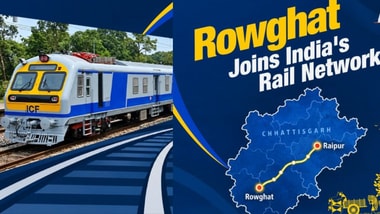
Indian Railways has brought Rowghat in Chhattisgarh onto the national railway network for the first time since Independence, improving connectivity to remote parts of the state. The Tadoki–Rowghat and Abhanpur–Kurud broad-gauge railway sections were inaugurated on Tuesday, with two new passenger train services also launched.
Chief Minister Vishnu Deo Sai attended the inauguration, while Union Railway Minister Ashwini Vaishnaw participated through video conferencing. The programme also included the foundation stone laying for an electric locomotive maintenance facility in Raipur.
The new rail links are expected to strengthen transport infrastructure in southern Chhattisgarh, offering residents better access to essential services and economic opportunities.
The inauguration of the Tadoki–Rowghat section marks the completion of the 95-km Dalli-Rajhara–Rowghat railway line, constructed at a cost of ₹1,628 crore. The project was completed with the opening of its final 17.5-km stretch between Tadoki and Rowghat.
The arrival of trains in Rowghat is a significant development for the region’s residents, who have had limited transport options. The new connection is expected to make travel more convenient and improve access to education, healthcare, employment and markets.
Addressing the gathering, Vishnu Deo Sai said development initiatives across Chhattisgarh, including railway infrastructure projects, were progressing steadily. He highlighted that the state had received an allocation of more than ₹7,000 crore under the current Railway Budget.
Sai said the new railway infrastructure would improve connectivity in remote areas and contribute to industrial growth, trade and broader socio-economic development.
Two passenger train services, Rowghat–Raipur and Raipur–Kurud, were flagged off during the inauguration programme. The services are expected to improve access to Raipur, the state capital, while offering more convenient travel options to people living along the routes.
The new connections could also facilitate daily commuting and regional trade by making travel between smaller towns and major commercial centres easier.
Apart from passenger connectivity, the railway line is expected to facilitate the transportation of iron ore from the Rowghat region. The area has significant iron ore resources that can contribute to India’s steel industry, including operations at the Bhilai Steel Plant.
Rail connectivity can make the movement of raw materials more efficient, helping industries meet their requirements and strengthening supply chains. Better transport links could also encourage economic activity and generate employment opportunities in surrounding areas.
Railway Minister Ashwini Vaishnaw congratulated the people of Chhattisgarh on the completion of the railway projects and the introduction of the new passenger services. He said railway infrastructure across the state was being expanded through new lines, gauge conversion and additional tracks.
The projects highlighted included the Dalli-Rajhara–Rowghat railway line, gauge conversion on the Kendri–Abhanpur–Rajim–Dhamtari section and other track development works.
Construction is currently under way on the Kharsia–Parmalkasa double-line project. The Union Cabinet has also recently approved a third railway line connecting Pendra Road, Bilaspur and Uslapur.
These initiatives aim to increase railway network capacity, improve passenger connectivity and support industrial and economic development across Chhattisgarh.
The Abhanpur–Kurud broad-gauge railway section was also inaugurated as part of the programme. The 22-km stretch forms part of the Abhanpur–Dhamtari railway project, which aims to expand broad-gauge connectivity in the region.
Passenger services are already operational between Abhanpur and Rajim following gauge conversion work. Construction on the remaining Kurud–Dhamtari section is continuing and is expected to be completed shortly.
The opening of the Abhanpur–Kurud stretch is expected to provide additional travel options for passengers heading towards Raipur while supporting local businesses, regional commerce and daily commuting.
(With inputs from news agency ANI)