Gurugram: Every morning, Sumit Tayal, 38, a resident of Ballabgarh in Haryana, takes a state roadways bus to reach Sadar Bazar, the old shopping district in Gurugram. Tayal has been working at a garment store in the market for more than a decade. Over the years, as traffic on the roads multiplied, it took Tayal more and more time to cover the 45-km distance between Ballabgarh and Gurugram. These days, it takes him about two and a half hours each way, or five hours of commute—daily.
Tayal makes this journey every day of the week, including on weekends. But the most distressing part of the ride is the air he is forced to breathe and the unmeasured quantities of dust he inhales.
“The roads are very dusty and trucks carrying construction material and debris without a cover add to the problem,” Tayal said.
As a consequence, he often suffers from coughing bouts and respiratory tract infections, which intensify during the winter months when air pollution levels spike.
Tayal is a fervent advocate of public transport and joined Clean Air Bharat, a citizen activist group with chapters in multiple cities. “Because I post on (civic) issues like illegal waste burning and unpaved or dug up roads, my social media account is blocked repeatedly,” Tayal said.
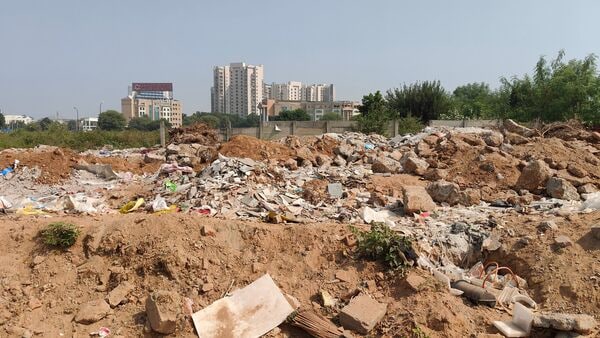
Nirvana Country, in another part of Gurugram in Sector 50, is a world away from the chaos of Sadar Bazar. It is a gated residential society comprising independent houses, with a planned layout and lush greenery. It appears to be an ocean of calm compared to the din and dust that engulfs it—a debris hill on the edge and roads laden with dust. A conversation with a resident here bridges the miles separating Nirvana from Sadar Bazar.
Anup Sood, who moved into Nirvana in 2007, says it’s been a downhill journey when it comes to quality of life. Sood’s son was born in 2010 and the child was diagnosed with allergic rhinitis (inflammation of nasal passages as a reaction to airborne allergens) when he was just five, following exposure to dust and dirty air. His son, now 16, is unable to take part in physically demanding sports like football. The winters are a tough time for the family as the kid often suffers from wheezing and needs frequent nebulization.
“We are seriously contemplating moving out of Gurugram to a place where the air is breathable,” Sood said.
Ruchika Sethi, who founded Clean Air Bharat in 2016, also a resident of Nirvana, minces no words while describing the situation in the city: “Living here reminds me of the iconic (1979) film Kala Patthar and the mine workers covered in soot. In the Gurugram of 2026, the black soot is replaced by a grey-white film of dust.”
The sources of dust, Sethi says, are local and very controllable. Most of it comes from dumping of construction and demolition waste in open areas, following little or no dust management protocols during construction, and unpaved and dug up roads.
“In Mumbai, they have the Malabar Hills (an upscale residential area) but what we have here are ‘malwa’ hills,” she said.
Malwa is Hindi for construction debris. Sethi has seen countless such hills gain height over the years, including one which abuts her home in Nirvana Country.
Gurugram’s rapid transformation from a quiet backcountry to a rapidly urbanizing corporate hub at the turn of the century earned it the moniker ‘millennium city’. In reality, it scorches in summer, floods during monsoon, and turns into a gas chamber during winter. The dust, however, is always around, like a shroud hanging over the metropolis.
Air pollution in the Delhi-National Capital Region is no longer a problem , said Arunesh Kumar, a pulmonologist. “Prolonged exposure is leading to COPD (chronic obstructive pulmonary disease) and asthma. We are increasingly seeing such cases among non-smokers. Similarly, I am seeing cases of lung cancer among young patients who are non-smokers and have no family history of cancer,” he said.
Yet, Gurugram is not an exception. Many Indian cities have literally turned into dustbowls. Silt loads on Indian roads are 25-30 times more than in developed countries, found a 2024 paper by researchers from the Indian Institute of Technology (IIT), Delhi and Kanpur (published in the journal Science of the Total Environment).
The researchers, who collected data from 259 locations in 32 cities across India, found that road dust levels exceeded World Health Organization (WHO) guidelines in 55% of cases. They estimated that about 10,000 lives are lost annually due to PM2.5 pollution attributable to road dust.
The State of the Global Air Report 2025, put together by the Boston-based Health Effects Institute and the Institute for Health Metrics and Evaluation, located at the University of Washington School of Medicine, attributes more than two million deaths in India to air pollution.
refers to particulate matter less than 2.5 microns in size while PM10 are larger particles with a diameter of less than 10 microns; both are harmful pollutants that are easily inhalable due to their tiny size. The IIT study also noted that road dust emissions contribute 30-60% of PM2.5 and PM10 levels in metropolitan regions in India.
A 2026 working paper by WRI India, an environment think tank, found that silt load values in three cities—Mumbai, Ahmedabad and Indore—varied between one and 20 gram/square meter (a measure of the weight of dust over a specific area). The highest silt load values seen on certain stretches of these cities were 6.8 gram/square meter in Mumbai, 4.9 gram/square meter in Indore and 19.7 gram/square meter in Ahmedabad, based on actual dust that was collected from the road tops (and not from the edges) and measured.
Secondary data cited in the report show that in a city like Milan in Italy the dust levels ranged between 0.006-0.066 gram/square meter. The globally accepted standard is less than 1-2 gram per square meter.
The three cities studied by WRI India are using a combination of manual, water-based and mechanical cleaning to remove dust. However, the dust returned to pre-cleaning levels within four to eight days after cleaning.
The dust levels on roads are influenced by multiple factors ranging from geography and soil conditions to windspeed and humidity, explained Sree Kumar Kumaraswamy, programme director at WRI’s Clean Air Action unit and an author of the report.
“Once wind-blown dust is generated and settles on the road, it keeps getting resuspended due to vehicular movement, reacts with tire and brake wear dust, forming more toxic compounds,” Kumaraswamy said.
The toxicity level of road dust is a less understood aspect with scant data available. WRI has sent samples from Mumbai for chemical analysis.
However, it is clear that road dust is more than just benign soil particles that can be washed away. Kumaraswamy said that in Indian cities, movement of heavy vehicles, road condition and age, and dust on road shoulders are critical factors. “A big problem for Indian cities is that the road surface is not treated edge to edge. This adds to both resuspension and emissions,” he said.
By ‘edge to edge’, he means that Indian roads are often not paved with asphalt, bitumen, or concrete across its entire width.
Interestingly, as per WRI, more than 60% of the government funds for tackling air pollution are spent on dust management, under the National Clean Air Programme (NCAP). These include solutions like end-to-end paving of roads, use of mechanized road sweepers, development of green areas and establishing sites to process construction waste.
Since the launch of NCAP in 2019, the government has allocated nearly ₹16,500 crore to clean the air across 130 Indian cities. As per the environment ministry, between FY18 and FY25, 64 of the 130 cities have reduced annual PM10 emissions by 20% or more; however, only 22 have so far met the national ambient air quality standard for PM10 emissions (60 microgram/cubic meter). These numbers are as per a response by the ministry to a question raised in the upper house of Parliament in December 2025.
Solutions like mechanized sweeping are increasingly deployed despite limited evidence.
“Cities report indicators such as the length of roads cleaned, the number of machines used, or the frequency of cleaning. These indicators are useful but do not directly show how much dust has been removed or pollution been reduced,” said the WRI report quoted earlier.
Besides, the technology is not standardized—which means that during vacuum cleaning, machine exhausts often release finer particles back into the air, said Dhirendra Singh, CEO at Airshed Planning Professionals, a Kanpur-based firm that specializes in air pollution source apportionment studies.
Singh, who coauthored the 2024 research paper with the IITs, cited earlier, added that disposal of collected dust is another problem as it is most likely getting dumped at landfills while ideally it should be stabilized in a slurry form to ensure that the collected dust does not return to the environment.
A cross-city analysis for Mint by Respirer Living Sciences, a climate-tech startup, shows that as of 2025, road dust and construction is a significant contributor to PM10 pollution. For instance, in cities like Delhi, Mumbai, Kanpur and Surat, road and construction dust were the leading sources, accounting for more than 30% of PM10 pollution.
“For years, India’s air quality debate was dominated by winter smog across northern India. But even when the winter smog clears, the dust remains,” said Ronak Sutaria, founder and CEO at Respirer.
While PM2.5 dominates the air pollution debate, PM10 remains a persistent threat, coating our surroundings and entering our lungs every day. And unlike PM2.5, which can be dispersed across a city, PM10 levels can vary significantly from one street to another.
“It is for this reason that we need clear, location-specific data showing where the pollution originates and where the levels are highest. To improve air quality and protect public health, authorities must first invest in digital systems that collect reliable, location-specific data before spending heavily on pollution-control measures,” Sutaria added.
He suggested a combination of measures to tackle the dust menace. These include transitioning from haphazard manual sweeping to the deployment of GPS-tracked mechanical vacuum sweepers on paved arterials, targeted where daily data shows PM10 spikes.
Cities can move beyond temporary water sprinkling to the use of bio-degradable dust suppressants on unpaved roads and construction sites, which bind soil particles together for weeks at a time.
In addition, data-driven heat maps can direct municipal squads to specific violations, turning environmental enforcement into a proactive, rather than reactive, exercise.
Cities can also plant multi-tier vegetation along known, hyper-local dust corridors to physically trap resuspended particles before they enter residential zones.
Real-time monitoring is showing encouraging results in Mumbai. Last May, the city authorities mandated real-time monitoring in 3,000+ construction sites in Mumbai. When pollution levels cross a threshold, the project developer receives an alert to take action. This has led to a 10-15% drop in air pollution levels, as per Respirer.
Ruchika Sethi, the air pollution crusader from Gurugram, strongly feels that no solution will work unless dust is contained at originating sources like construction sites and unpaved road stretches.
After a decade of fighting for the right to breathe clean air, Sethi moved out of Gurugram to Goa, temporarily for three months, during the winter of 2025. This year, the family could be doing the same, again. She is aware this is a privilege that most people, particularly whose livelihoods are tied to the city, like Sumit Tayal, cannot afford.