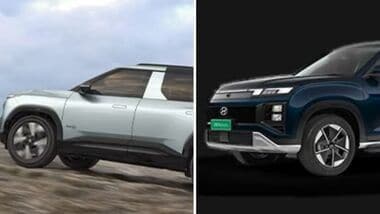
The Tata Sierra EV and Hyundai Creta Electric offer different propositions for buyers looking to purchase an electric SUV in India. While the Tata Sierra EV comes with battery options of 63kWh and 75kWh, including an all-wheel-drive (AWD) configuration, the Hyundai Creta Electric is available with 42kWh and 51.4kWh battery packs.
The Tata Sierra EV starts at ₹18.79 lakh, while the Hyundai Creta Electric has a starting price of ₹10.99 lakh under the Battery-as-a-Service (BaaS) programme, which offers the battery on rent.
Here is a comparison of the two electric SUVs across pricing, range, performance, features and safety.
The Tata Sierra EV is available in three configurations. The 63kWh rear-wheel-drive (RWD) variants are priced between ₹18.79 lakh and ₹22.79 lakh, while the 75kWh RWD variants cost between ₹22.19 lakh and ₹24.79 lakh. The top-spec 75kWh AWD variant is priced at ₹25.99 lakh.
The Hyundai Creta Electric’s BaaS starting price of ₹10.99 lakh excludes the battery, which is available on a rental plan starting at ₹3.9 per kilometre.
The Sierra EV’s claimed MIDC range stands at 535km for the 63kWh RWD version, 665km for the 75kWh RWD variant and 624km for the 75kWh AWD model. Tata also quotes a C75 range of 440-460km, 510-530km and 480-500km, respectively.
The Creta Electric offers a claimed range of 420km with its 42kWh battery and 510km with the 51.4kWh battery.
The Tata Sierra EV’s RWD variants produce 235bhp and 315Nm with the 63kWh battery, and 206bhp and 315Nm with the 75kWh battery. The AWD version adds a 138bhp front motor, taking combined torque to 504Nm. Tata claims a 0-100kmph acceleration time of 5.8 seconds.
The Hyundai Creta Electric can accelerate from 0-100kmph in a claimed 7.9 seconds. It offers Normal, Eco and Sport driving modes, while the Sierra EV gets four driving modes and six terrain modes in its AWD configuration.
For charging, the Sierra EV supports 120kW DC fast charging, with a claimed 20-80% charging time of 26 minutes. The Creta Electric takes a claimed 39 minutes to charge from 10% to 80%. Both offer AC home-charging options.
The Sierra EV gets a triple-screen infotainment setup, a 12.3-inch touchscreen, a 10.25-inch digital instrument display, a head-up display, ventilated seats, a panoramic sunroof and a 12-speaker JBL sound system. It also offers a 540-degree camera, vehicle-to-load (V2L) and vehicle-to-vehicle (V2V) charging, along with 622 litres of boot space.
The Creta Electric features dual 10.25-inch displays, a panoramic sunroof, a Bose eight-speaker sound system, a digital key, Bluelink connected-car technology and V2L functionality.
Both SUVs offer six airbags and Level 2 advanced driver-assistance systems (ADAS). The Creta Electric includes features such as lane-keeping assist, blind-spot collision avoidance and smart cruise control.
The Tata Sierra EV comes with a lifetime high-voltage battery warranty of 15 years from first registration, an eight-year or 1,60,000km motor warranty and a three-year or 1,25,000km vehicle warranty. Hyundai offers an eight-year or 1,60,000km battery warranty for the Creta Electric.
The Tata Sierra EV may appeal to buyers seeking a longer claimed range, stronger performance and an AWD option. The Hyundai Creta Electric, meanwhile, offers a lower initial outlay through BaaS, two battery choices and a comprehensive technology package. Buyers should compare the total ownership cost, including battery rental where applicable, before making a decision.