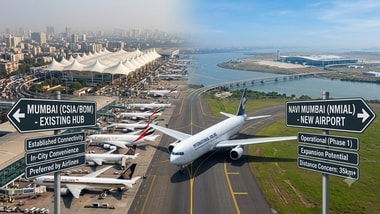
Airlines operating from Mumbai are reportedly resisting a proposed transfer of international flights to Navi Mumbai International Airport, citing higher operational complexity, commercial concerns and a lack of agreement over existing flight slots. The dispute comes as Chhatrapati Shivaji Maharaj International Airport prepares for redevelopment that will temporarily reduce its annual passenger-handling capacity by around 5 million from the summer of 2027.
According to The Economic Times, Mumbai International Airport Ltd (MIAL), controlled by the Adani Group, has told airlines they can shift some or all of their operations to Navi Mumbai, suspend services until Terminal 1 reopens in 2030, or explore other options.
The Airline Operators Committee (AOC), which represents commercial airlines, has opposed any suggestion that its members have agreed to transfer international operations or surrender their existing slots at Mumbai airport.
The proposed move is linked to the redevelopment of Terminal 1 at . MIAL says the work will temporarily reduce the airport’s annual capacity by about 5 million passengers. The existing airport can handle around 55 million passengers a year.
MIAL has said airlines can independently decide their operating plans for the summer 2027 schedule, known as S27. It has also promised to restore their historic slots after Terminal 1 reopens in 2030.
The airport operator has described consultations with airlines’ network-planning teams as voluntary discussions intended to explore alternatives.
However, the proposal has triggered a dispute over whether international traffic can be transferred to Navi Mumbai without airlines’ consent.
The AOC has stressed that discussions with MIAL do not amount to approval of the proposed transfer or any reduction in existing flight slots.
“AOC member airlines have not agreed to the proposed transfer of international operations from CSMIA to NMIA, nor consented to any reduction or cancellation of its allocated slots at CSMIA,” the committee said, according to The Economic Times.
The committee has also questioned the need for capacity restrictions. It pointed to ‘s existing passenger-handling capacity of less than 10 million passengers a year and an expected additional capacity of 5 million passengers at Terminal 2 by March 2027.
The AOC has argued that MIAL has not provided sufficient evidence to justify reducing or cancelling slots.
It has sought a detailed Terminal 1 redevelopment plan covering construction work, structural safety assessments, project timelines and terminal-wise capacity and utilisation data.
The committee has asked MIAL to respond by 5 pm on 21 October and confirm that it will not unilaterally change traffic allocations or slots while consultations and regulatory requirements remain unresolved.
For international airlines operating relatively few flights to Mumbai, maintaining services from two airports serving the same city could prove commercially difficult.
The are around 50 km apart, creating additional challenges for coordinating aircraft, crew, maintenance and passenger connections.
Airlines must also consider the cost of managing ground services and equipment across separate locations. For carriers operating limited services, these additional arrangements could complicate schedules and affect the commercial viability of their Mumbai operations.
The AOC has asked MIAL to follow the Ministry of Civil Aviation’s May 2013 slot-allocation guidelines and the International Air Transport Association’s Worldwide Airport Slot Guidelines.
The two sides are scheduled to meet on 28 October to discuss the proposed arrangements.
MIAL has maintained that airlines are free to decide how to organise their services for the summer 2027 schedule and has promised to restore historic slots after Terminal 1 reopens in 2030.