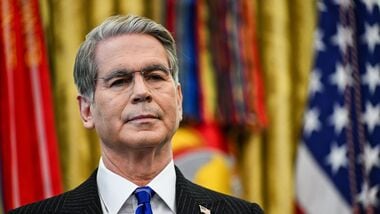
US Treasury has said European countries refused Washington’s request to impose secondary tariffs on India and China for buying Russian oil. He questioned why the United States should bear the economic burden of putting pressure on Russia alone.
In an interview with NBC, Bessent said the Trump administration had approached its European allies in the spring to seek joint action against countries importing Russian energy.
“So we have asked—in the spring, I asked our European allies to join us in putting secondary tariffs on China, on India. They refused. So why should the US bear the burden?” Bessent said.
Bessent said wanted the fighting in Ukraine to stop. He also referred to proposed sanctions legislation that would give the administration time to assess the situation before deciding on further action.
“President Trump has made it clear he wants the killing to stop. And the so-called Graham bill gives the president the flexibility, gives him 60 days to assess the situation,” he said.
The proposed legislation would provide the US administration with a 60-day period to assess developments before deciding how to proceed.
Bessent also criticised European countries for continuing to buy Russian energy, pointing to shipments from Russia’s Yamal facility.
“In the first 6 months of the year, there were 140 cargoes that left. 136 of those went to Europe—to Belgium, to Spain, to France, to the Netherlands—over USD 8 billion,” he said.
He argued that European countries had continued to provide Russia with substantial revenue through energy purchases while also supporting Ukraine in its war against Russia.
His remarks come after Trump temporarily waived certain sanctions and tariff provisions under the Lindsey O. Graham Sanctioning Russia and Iran Act of 2026, allowing the administration 60 days to assess the potential economic consequences of implementing the measures.
The legislation would have allowed tariffs of up to 100 per cent on goods imported into the United States from the five largest importers of Russian-origin crude oil or natural gas, including India and China.
US Secretary of State Marco Rubio on Saturday described India as an important ally, saying Washington needed to consider its energy requirements before imposing tariffs or sanctions.
“These sanctions were not just sanctions on Russia. They include tariffs on a number of countries—India, for example, and others,” Rubio said, adding that the administration wanted to evaluate the implications for the global and US economies.
Rubio also noted that countries such as India had diversified their energy supplies but could not immediately stop importing Russian energy.
The US administration’s decision comes amid continuing pressure on global energy supplies due to the Russia-Ukraine conflict and escalating tensions in the Middle East.
Bessent said Washington could engage with European partners again, questioning why the United States should act alone in imposing economic pressure on Moscow.
(With inputs from news agency ANI)