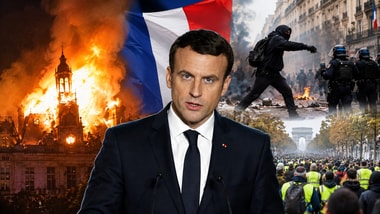
France has witnessed a fresh wave of protests, with students, teachers, trade unions and activists linked to the Yellow Vest movement taking to the streets over rising living costs, pressure on public services and broader economic grievances.
Demonstrations across several cities turned violent, with reports of looting, arson and clashes between protesters and police.
While hundreds of thousands of people reportedly joined marches across the country, violent groups targeted public buildings, damaged property and looted shops, including luxury boutiques and supermarkets, according to reports by AFP and The Associated Press.
The unrest has revived questions about whether France is seeing a resurgence of the anger that fuelled the movement in 2018, when protests over fuel prices and the cost of living developed into a wider challenge to ’s economic policies.
Violence was reported in several French cities on Saturday. In Limoges, a fire engulfed the 19th-century city hall. Maurice Barate, the prefect of Haute-Vienne, told French broadcaster LCI that the blaze had been deliberately set, according to media reports.
In Marseille, protesters reportedly broke into the city hall and defaced parts of the building with graffiti.
In Lyon, the city’s tourist office was reportedly set on fire. Masked groups also attacked public buildings, set fires and clashed with police in other locations, says reports.
Paris and several other cities witnessed looting as masked youths targeted commercial establishments amid demonstrations against inflation and the rising cost of living.
The scale of the has put pressure on authorities to restore order while addressing the economic and social concerns driving the protests.
French Prime Minister Sébastien Lecornu said the government would not be intimidated by violence, accusing far-left groups and criminals of seeking to exploit the unrest ahead of next year’s presidential election.
“To those who clearly want to use this violence as a ‘warm-up’ before the presidential election, I say clearly: We will not let ourselves be intimidated. No one will impose their political agenda through violence,” wrote in a post on X.
President Emmanuel also vowed to prosecute those responsible for the attacks, saying the country would stand together against groups seeking to undermine public institutions and disrupt peaceful demonstrations.
French police reportedly arrested at least 1,800 people nationwide following clashes and incidents of looting, according to reports.
US President Donald weighed in on the unrest on Sunday, blaming immigration for the violence in a post on his Truth Social platform.
“France is burning! The immigration of people from an entirely different world, people with hatred in their hearts, has shattered that once great country,” Trump wrote.
His remarks came as authorities dealt with clashes in cities including Paris, Nice and Marseille. Trump’s statement offered his interpretation of the unrest; the protests have also been linked to rising living costs, concerns about public services and wider political grievances.
The demonstrations have drawn attention beyond France, with smaller protests also reported in Belgium, Portugal and Italy amid concerns over the cost of living across Europe. In , protesters again rallied over alleged government corruption, unemployment and education standards.
The Yellow Vest movement, known in French as Mouvement des gilets jaunes, is a grassroots protest movement that emerged in France in 2018. It takes its name from the high-visibility yellow vests that motorists in the country are required to keep in their vehicles.
The movement began on November 17, 2018, largely in response to rising fuel prices and living costs under .
It soon expanded into a broader protest against economic inequality, perceived government indifference to working-class concerns and the cost of everyday life.
The demonstrations drew support from people across different social and economic backgrounds, including workers and residents of smaller towns who felt left behind by economic policies. Weekly protests continued until June 2020, when activity subsided during the
The movement became one of the most significant challenges to Macron’s presidency, highlighting the political consequences of policies perceived as placing a disproportionate burden on ordinary households.
According to Al Jazeera, former Yellow Vest figures and activists joined high school students, teachers and trade unionists in demonstrations on October 17 across major cities, including Paris, Marseille, Rennes and Saint-Étienne.
The key question is whether these demonstrations develop into a sustained nationwide movement comparable to the Yellow Vest protests, or remain a broader but fragmented expression of public discontent.