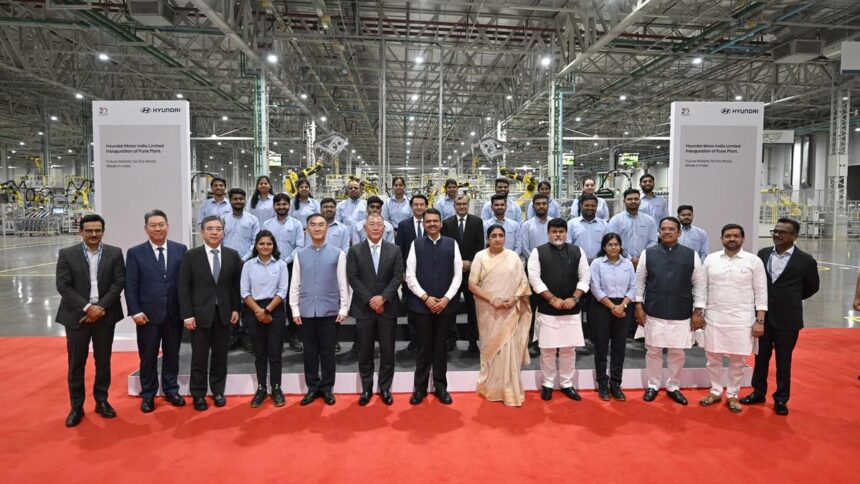
Hyundai Motor Group plans to introduce four electric vehicles in India by 2029, including an entry-level model and an electric SUV, expand its hybrid and alternative-fuel portfolio, explore domestic battery-cell manufacturing and establish a dedicated investment entity, HMG India, as the country emerges as its second-largest region after North America, ahead of Europe and South Korea.
At a joint media briefing in Pune on Wednesday, senior executives outlined plans to allocate $6.2 billion towards new technologies and research and development through 2032, with $3.1 billion earmarked for each. The investments will support artificial intelligence, startups, automotive engineering and future mobility. Executives did not specify the metric behind India’s regional ranking.
“India remains one of Hyundai’s most important and strategic markets globally,” said Euisun Chung, Executive Chair of Hyundai Motor Group. “The inauguration of the Pune plant reflects our long-term commitment to India’s growth and our confidence in its bright future.”
Hyundai is pursuing localisation of battery packs and power electronics while evaluating domestic battery-cell manufacturing to reduce import dependence and improve electric-vehicle affordability.
Executives discussed engagement with Exide Industries on battery-related opportunities, although no specific cell-manufacturing investment, production capacity or commissioning schedule was announced.
The distinction is significant because locally assembled battery packs may still depend on imported cells, which account for a substantial portion of battery costs.
Hyundai’s electric-vehicle programme will target multiple customer segments, while hybrids and other alternative-fuel technologies will provide additional options for buyers.
HMG India is intended to coordinate investments across group businesses, emerging technologies and mobility services, extending Hyundai’s activities beyond conventional automobiles.
Hyundai’s research collaboration network spans seven leading Indian institutions, with nearly 40 ongoing projects covering battery technologies, electrification and future mobility.
The company is strengthening industry-academia partnerships and local engineering capabilities to develop technologies suited to Indian operating conditions and consumer requirements.
“The inauguration of our Pune plant marks the beginning of HMIL’s next chapter of growth in India,” said Tarun Garg, Managing Director and CEO of Hyundai Motor India. He added that the facility would drive “industrial development, innovation and employment generation in the region.”
Hyundai executives also discussed micromobility opportunities involving TVS Motor Company, although specific products, investments and launch schedules were not disclosed.
The broader strategy reflects Hyundai’s efforts to develop India as a centre for electric-vehicle engineering, battery research and emerging mobility businesses.
Its success will depend on translating technology investments, local research partnerships and battery localisation into affordable vehicles and commercially viable mobility solutions.
Published on October 15, 2026