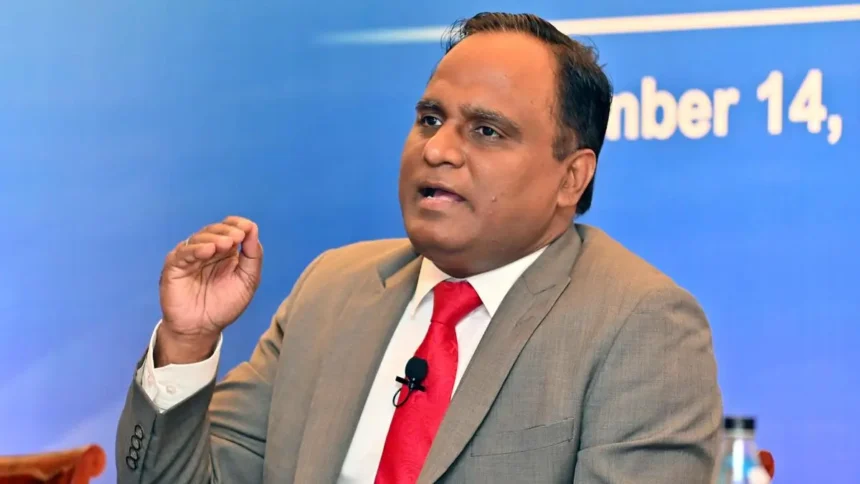
State-run Oil India Ltd (OIL) will aggressively pursue exploration of oil and gas assets in India’s deep and ultra deep waters, emphasised its Chairman Ranjit Rath adding that, the E&P major will also acquire stakes in producing fields abroad to build a diversified, balanced and resilient overseas portfolio.
Edited excerpts:
How is Oil India planning its consolidation exercise?
As part of our overseas assets, we would continue to look at more prospective areas. We would look at both producing and exploration assets, but primary interest will be producing assets, which will give us an immediate monetisation opportunity.
Recently, we dispensed with two assets as part of our consolidation effort. Two are in Bangladesh and one in Gabon. In our Mozambique asset, which was earlier in force majeure, on-ground work is going on full steam, and about 40 per cent is the construction progress. As far as exploration is concerned, that will be our mainstay domestically.
As part of our assessment, we are looking at all the geographies across the world, whether it is North America, South America or Africa, though we haven’t identified a specific area. We scan this on a continuous basis and also talk to our sister companies for collaborations, and even acquisitions.
How has your training as a geologist helped you conceptualise OIL’s E&P expansion?
While I am a geoscientist by training, I am also the Chairman of an oil and gas company. It gives me a two pronged vision. One helps me understand the uncertainties associated with geological setting of the areas where we intend to do exploration. Secondly, having had an understanding of it gives us the strength to pursue a more risk-taking ability in terms of our capital commitments. The no-go zone of about 1 million sq km, which was earlier not there for exploration, is now available under OALP IX, X, XI and going ahead.
What is the status of the blocks OIL secured under OALP?
We have already got OALP IX block, 48,000-50,000 sq km. The initial geological analysis indicates that it is worth considering for doing exploration and absolute rank wildcat drilling. Therefore, we have already identified a corpus of about ₹15,000 crore for this. The exact release of location will be contingent upon the processing, which is underway and the interpretation thereof. But we are very hopeful that we will be able to look out at least four plus four wells.
What are your thoughts on Samudra Manthan?
We are very well aligned with the Samudra Manthan Mission, which government of India wants to support deep water and ultra deep water exploration efforts. I must tell you, globally, nowhere such an initiative has been taken where in a revenue-sharing regime, central government or any state government is sponsoring exploration efforts. We are very well aligned, and this will be our mainstay.
While our onshore exploration will be carried out through our internal accruals. We will also take advantage of the Samudra Manthan Mission to carry out our drilling. This also gives us access to the data, which as part of Samudra Manthan Mission about $2.5 billion is identified for carrying out 2d and 3d seismic (study) in East coast and West coast of India in its exclusive economic zone and in Andaman Basin. So we will benefit from the stratigraphic well. We’ll benefit from the seismic data that will be made available, and this allows us to take that risk and commit that capital, which is also sponsored by government of India.
What is the interest for technical partnerships for OALP bidding rounds?
Our collaboration opportunities are in discussion stages. Since we have got confidence in the agreement, I will not want to reveal. But when we will submit the bids, you will come to know. There is a quality response (on OALP). More importantly, since we have got the Andaman discovery, which means we have established the Andaman Basin as a petroliferous basin. Now there is a push from the government in terms of data availability, in terms of sponsoring the wealth cost up to a threshold. So there is a lot of interest within the global (community).
What are your production targets?
As far as our production is concerned, it will come from the northeastern part of our main producing area. This year, our target is to do 4 million tonnes of crude oil. It will come from the Northeast. Upside is happening in Rajasthan fields, where earlier we were doing about 200-300 barrels a day. Today we are doing 1200 barrels per day. For natural gas, once the Duliajan feeder line happens, 18 months down the line, we’ll be able to take it to five billion cubic feet. So the production focus will remain in the Northeast till we get a big discovery.
Published on October 14, 2026