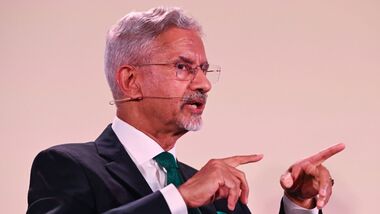
India’s trade negotiations with the United States are moving in the right direction, External Affairs Minister S Jaishankar said on Tuesday, 13 October, signalling continued efforts to finalise an agreement despite differences over tariffs and market access.
Jaishankar’s remarks offer a positive indication from New Delhi as the two countries attempt to conclude a trade pact that has taken longer than initially anticipated. A deal is still being worked out, however, and his comments do not mean that a final agreement has been signed.
The minister’s assessment comes amid uncertainty over changing tariff policies and their implications for Indian exporters. The negotiations have become an important part of the broader relationship, with both sides seeking to strengthen commercial ties while protecting their domestic economic interests.
According to financial news service Newsquawk, Jaishankar said the talks were heading in the right direction and that a deal was being ironed out.
India and the US announced a framework for the first phase of their bilateral trade agreement in February 2026. Subsequent changes to American tariff policy, however, complicated the process and prompted further discussions.
In September, Jaishankar acknowledged that the negotiations had been more complex than expected, pointing to differences between the two economies and the need to protect sensitive domestic sectors.
India has a large base of small manufacturers, agricultural producers and whose interests could be affected by changes in import duties and market access.
New Delhi has therefore sought to ensure that any agreement offers Indian exporters competitive terms without exposing vulnerable sectors to excessive pressure.
At an event hosted by the Asia Society in , Jaishankar said the two sides had reached a stage where there was “more or less an understanding on the trade agreement”. He also cautioned that the remaining issues required careful consideration.
One of the key complications is the evolving American tariff framework, including the ongoing Section 301 process. The provision allows the to investigate foreign trade practices it considers unfair and potentially impose additional duties.
Jaishankar has questioned when India should conclude an agreement while aspects of the US tariff regime remain unsettled. The uncertainty matters because Indian exporters need clarity on the duties their products will face in the market.
India is also seeking tariff terms that allow its businesses to compete effectively with exporters from other countries.
Reuters reported on 6 October that the negotiations had encountered fresh , with officials describing limited progress towards an imminent deal.
Trade has become a significant source of friction between New Delhi and Washington, alongside disagreements on other diplomatic and economic issues.
Jaishankar has previously said that concluding the agreement could help put bilateral relations on a better footing. For , a settled framework could provide greater certainty on tariffs, market access and investment.
For now, his latest remarks suggest that negotiations remain active, but important questions are unresolved. The next step will be to translate the stated progress into an acceptable to both governments.
Until the terms are formally concluded, Indian exporters and US businesses will have to contend with uncertainty over the future trading arrangements between the two countries.