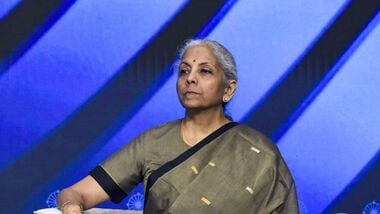
NEW DELHI: Finance minister Nirmala Sitharaman pitched India’s investment opportunities to global institutional investors and financial institutions during a four-day visit to Singapore, highlighting infrastructure, semiconductors, artificial intelligence (AI), renewable energy and financial services as key areas for greater capital flows, the finance ministry said in a statement on Monday.
The visit, from 8 to 11 October, included meetings with Singapore’s political leadership, financial authorities and major global investors, including BlackRock, JPMorgan Chase, Temasek, GIC, Carlyle and the Abu Dhabi Investment Authority (ADIA).
encouraged investors to explore opportunities through the National Investment and Infrastructure Fund (NIIF) and the Gujarat International Finance Tec-City International Financial Services Centre (GIFT IFSC). The government also highlighted select infrastructure projects for potential investment.
Discussions focused on mobilizing long-term institutional capital for India’s infrastructure and development priorities and strengthening bilateral investment and financial cooperation, the ministry said.
At a roundtable with global investment firms, participants discussed India’s economic resilience amid global uncertainties, financial market developments and the implications of rapid advances in AI. Investors expressed confidence in India’s growth prospects and called for predictable, fiscally prudent and growth-oriented policies, alongside continued infrastructure investment.
Separate meetings with senior executives of financial institutions and global corporations, including Mitsubishi UFJ Financial Group, Standard Chartered Bank, DBS , Wellington Management, TPG, Intel and British International Investment, covered opportunities across several sectors.
Discussions spanned consumer markets, start-ups, financial technology, healthcare, manufacturing, micro, small and medium enterprises, and trade finance. Other areas included data centres, semiconductors, renewable energy, electric mobility and aviation maintenance, repair and overhaul services.
Meetings with Singapore’s financial authorities explored cooperation in emerging financial technologies, including asset tokenisation, digital money, central bank digital currencies and interoperable payment and settlement systems.
The Monetary Authority of Singapore shared its approach to developing the digital asset ecosystem, including asset tokenization. Both sides discussed potential efficiency gains, regulatory challenges and the need for trusted settlement arrangements, the finance ministry said.
The two countries also reviewed progress on the outcomes of the fourth India-Singapore Ministerial Roundtable and discussed ways to deepen their comprehensive strategic partnership. Talks covered capital markets, payments connectivity, digitalization, semiconductors, AI and cybersecurity, as well as stronger India-ASEAN economic cooperation ahead of Singapore’s ASEAN chairmanship in 2027.
Sitharaman also met Singapore President Tharman Shanmugaratnam, Prime Minister Lawrence Wong, Deputy Prime Minister and Trade and Industry Minister Gan Kim Yong, and Foreign Minister Vivian Balakrishnan.
India’s exports to Singapore fell 8.57% to $11.86 billion in FY26 from $12.98 billion in FY25, even as the two countries seek to deepen economic and investment ties.
Singapore remains a key trade and investment partner for India. It was India’s largest trading partner within ASEAN in FY25, with bilateral trade of $34.26 billion, and a major source of foreign direct investment. The two countries have a Comprehensive Economic Cooperation Agreement (CECA), in force since 2005, and are working to deepen trade and investment ties.