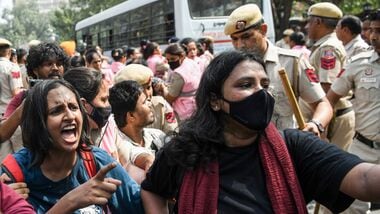
Widespread outrage erupted across social media following weekend demonstrations in central Delhi, where protestors gathered to demand the resignation of Chief Election Commissioner (CEC) over alleged irregularities in the Special Intensive Revision (SIR) of electoral rolls.
Several netizens and civil society groups have alleged that women protestors were manhandled by male police personnel and detained after dusk.
This has put a sharp spotlight on the statutory safeguards protecting women under the newly enacted Bharatiya Nagarik Suraksha Sanhita (BNSS), 2023, raising fundamental questions about the limits of police power during public demonstrations.
In one clip shared by a journalist, male security personnel could be seen physically grappling with and dragging demonstrators into transit vehicles.
While another video captured the distressed cries as female demonstrators were shoved into police buses, with netizens claiming the detentions continued past 6:00 PM.
This has sparked an immediate debate online: Can the police detain women after dark?
The core statutory protection governing nighttime is codified under Section 43(5) of the BNSS, which expressly prohibits the arrest of women after sunset and before sunrise except in strictly monitored situations.
Legal experts told LiveMint that the threshold for bypassing this protection is exceptionally high. “Section 43(5) of the BNSS lays down a clear safeguard that, ordinarily, a woman cannot be arrested after sunset and before sunrise,” explained Vaibhavi Sharma, Partner at Prosoll Law.
“While the statute does not exhaustively define ‘exceptional circumstances’, the exception cannot be invoked as a matter of routine or administrative convenience. There must be circumstances demonstrating a genuine necessity for an immediate nighttime arrest,” she added.
Dr Advocate Rishabh Gandhi, former Judge and Founder of Rishabh Gandhi and Advocates, agreed that routine protest policing does not qualify as “exceptional circumstances”.
“Although the statute does not exhaustively define such circumstances, they must be genuine, compelling, and capable of objective justification. Mere administrative convenience or a general apprehension of disturbance cannot automatically justify dispensing with statutory safeguards,” Gandhi noted.
He pointed out an important technical nuance: “Importantly, the restriction operates from sunset, not automatically from 6 PM.”
Prakhar Parekh, Partner at Rashmikant & Partners, elaborated on what legally constitutes such an urgency: “Exceptional circumstances would indicate situations where an extremely serious crime has been committed or failure of detention would lead to destruction of evidence.”
Even if an emergency exists, the procedural hurdle is non-negotiable. Sharma noted that the law requires a female officer to make a written report explaining the necessity and obtain prior written permission from a Judicial Magistrate First Class before any nighttime arrest can proceed.
Crucially, law enforcement cannot circumvent these rules by playing with terminology. “The police cannot circumvent statutory safeguards merely by describing what is effectively an arrest as temporary detention,” Gandhi cautioned.
Sharma added that establishing a violation depends heavily on “the precise nature and extent of restraint, the legal provision invoked, and the duration of detention.”
The viral reels—including one purportedly showing a male police officer inappropriately grabbing AISA activist Neha Bora before apologising for the wrongful touch—bring into sharp focus another critical statutory safeguard: the proviso to Section 43(1) of the BNSS.
“The law ordinarily presumes that a woman submits to custody upon oral intimation of arrest and prohibits a male police officer from physically touching her to effect the arrest unless the circumstances otherwise require,” explained Dr Rishabh Gandhi.
While the statute does not create an absolute bar to physical contact, Gandhi stressed that “such contact must be justified by the circumstances and cannot involve unnecessary or excessive force.”
Vaibhavi Sharma highlighted that the burden of proof falls squarely on the police if physical force is deployed by male officers: “The law proceeds on the basis that ordinarily a woman’s submission to custody on oral intimation of arrest is sufficient. Therefore, if male police personnel have physically grabbed, dragged, or restrained women protesters, the authorities would have to explain the circumstances necessitating such intervention.”
She noted that while the mere presence of male personnel does not invalidate an arrest, “unnecessary or disproportionate physical contact can amount to a violation of the statutory safeguard” and breach fundamental rights to dignity and bodily integrity under Article 21.
If police personnel are found to have breached these statutory safeguards, detainees have multiple constitutional and judicial avenues available, though practical hurdles remain.
“If a person continues to be detained without lawful authority, an immediate remedy is to approach the Delhi High Court under Article 226 seeking a writ of habeas corpus,” said Sharma. “The legality of the arrest can also be questioned before the Magistrate when the detainee is produced for remand.”
Even after release, victims can hold authorities accountable. Dr Gandhi noted that affected individuals can seek “an independent investigation, departmental proceedings, criminal prosecution of the officers concerned, and, in appropriate cases, monetary compensation for constitutional violations” under Articles 21 and 22.
However, pursuing criminal action against police officers in court comes with statutory roadblocks. “Since any prosecution of the police officers requires a government sanction, the process is likely not to yield a result in the short term,” observed Parekh, suggesting that detainees can also file representations before human rights commissions.
According to Sharma, judicial outcomes hinge on “the time and nature of detention, grounds of arrest, arrest memo and station records, video/CCTV footage, presence of women police personnel, nature of force used, and whether prior permission of the Magistrate under Section 43(5) was obtained.”
“If statutory safeguards were deliberately bypassed,” Sharma concluded, “the issue goes beyond a mere procedural lapse and raises a serious question of unlawful deprivation of personal liberty.”