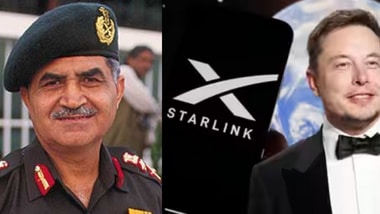
Former Ved Malik on Sunday expressed reservations about India relying on telecom systems owned by foreign companies, citing the US sanctions imposed during the Kargil War and Washington’s recent trade restrictions.
“With concern for national security, and my experience of defence sanctions imposed by USA during the Kargil war period and tariff and other restrictions imposed by US recently, I would not like to depend on any foreign-owned telecom system in India,” Malik wrote on X.
Malik served as the from October 1997 to September 2000 and led the Indian Army during the 1999 Kargil War against Pakistan.
His tenure also coincided with sanctions imposed on India by the administration of then US President Bill Clinton in May 1998, following India’s nuclear tests at Pokhran.
The restrictions covered defence equipment sales, transfers of military technology, financial assistance and exports of sensitive dual-use technologies. Some of these curbs remained in force when the Kargil conflict began in May 1999, making it more difficult for India to access certain foreign defence supplies.
Malik’s remarks come as SpaceX CEO Elon Musk seeks regulatory approval for Starlink, the company’s satellite-based internet service, to operate in India.
Musk has criticised the Indian government over delays in granting permission for the service’s entry into the country. He has also alleged that influential business interests are preventing Starlink from entering the Indian market, a claim the government has denied.
India’s two biggest private telecom operators, Reliance Jio Infocomm Ltd. and Bharti Airtel, together account for roughly 910 million broadband subscribers, more than 80 percent of the country’s market, according to the latest government data cited by Bloomberg.
Musk’s broadside marks a sharp turn from last year, when SpaceX signed deals with Bharti Airtel and Reliance’s Jio Platforms Ltd. to offer Starlink’s services in India.
Bharti is one of the largest shareholders in Eutelsat Communications, operator of the Eutelsat OneWeb satellite network that’s one of Starlink’s biggest low-Earth orbit competitors worldwide.
Reliance has its own satellite ambitions through Jio Satellite Communications and its joint venture with Luxembourg-based satellite operator SES SA.
Jio, OneWeb and Starlink are among the three companies that have received India’s satellite-communications licenses, although none has yet fully switched on commercial services, Bloomberg reported.
In June, it was reported that India had effectively frozen final approvals for Starlink’s commercial launch due to security concerns. Security agencies under the country’s home ministry withheld clearances for the low-Earth orbit service to begin operations, sources had told Bloomberg.
Starlink has secured a satellite communications license in India, but is still waiting for the security clearances as well as the spectrum before it can switch on commercially.