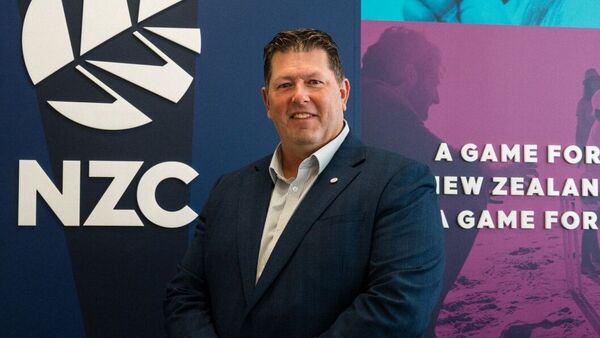
New Zealand Cricket expects India’s upcoming tour to lift its revenue by about 50% over a normal year, underscoring the board’s reliance on Indian cricket to finance the game at home and its push to build a more stable business beyond marquee bilateral series.
The 12-match tour, comprising five T20 internationals, five one-day internationals and two Tests, runs from 22 October to 1 December across five centres in New Zealand. It is expected to help the board post a surplus of more than NZ$10 million, or approximately ₹54 crore, in the financial year ending July 2027 (FY27), newly appointed chief executive Geoff Allott told Mint in an interview.
“From a revenue side India is very, very important. We rely on the support of teams like India travelling to New Zealand so that we’re able to fund our communities and our kids,” Allott said.
The expected windfall follows a deterioration in the board’s near-term finances. New Zealand Cricket has revised its forecast deficit for FY26 to NZ$7.3 million from an earlier budgeted loss of NZ$1.8 million, according to recent media reports. Its earnings fluctuate with the international match schedule, distributions from the International Cricket Council (ICC) and the timing of sponsorship deals.
“Typically, countries like New Zealand might actually have two or three losses in a four- or five-year cycle. A tour like India is just so critically important,” Allott said.
The end of its partnership with fantasy gaming platform Dream11, following changes in India’s online gaming laws, has added to the pressure, though Allott said it was not the main reason for the revised deficit forecast.
India’s Promotion and Regulation of Online Gaming Act, 2025, prohibited online money games and their advertising and promotion. The law came into force in May 2026, affecting sponsorship opportunities for real-money gaming companies such as Dream11, which had sponsored New Zealand’s domestic Super Smash competition.
Despite the India series, New Zealand Cricket could still forecast losses over the next two years, Allott said. Its objective, however, is to remain profitable over a five-year period. The board is looking to control costs and develop new revenue streams to reduce its dependence on individual tours.
The challenge extends beyond balancing the books. New Zealand Cricket is also seeking to turn India’s commercial importance into a longer-term business opportunity, as broadcasters compete for audiences across formats and viewing habits shift towards digital platforms.
Sony Sports Network will televise the series in India, with SonyLIV streaming the matches. Sky Sport will handle broadcast and streaming in New Zealand. The series runs through November, including the Diwali period, offering broadcasters access to audiences during the festive season.
“The timing offers broadcasters an opportunity to reach cricket fans during the festive season, which is very important,” Allott said.
The board is developing a 10-year strategy to deepen its business ties with India, with the India-New Zealand free trade agreement also set to come into effect later this month.
“We’re really excited about the future and an opportunity to develop a decade-long strategy, looking at India and how we might be able to advance our relationships,” he said.
New Zealand Cricket wants to build on its broadcast partnership with Sony Pictures Networks India and find ways to reach more Indian fans. Allott said the shift from television to digital viewing was something cricket boards needed to adapt to rather than fear.
“We’ve all got to embrace it and develop and evolve with it and boards and broadcasters need to keep their content relevant as viewing habits change,” he said.
The ambition is to build a following beyond matches against India. “We want to be the Indian fan’s second-favourite team outside of India, of course,” Allott said.
New Zealand Cricket is also looking to benefit from franchise cricket. Allott described the decision to allow players to participate in the Indian Premier League as “one of the best decisions the board has made in a long time”, saying it had benefited coaches as well as players. The board now wants to create more opportunities for New Zealand’s women cricketers in the Women’s Premier League.
At the same time, reducing reliance on major bilateral tours, particularly those involving India, remains a priority. New Zealand will co-host the 2028 T20 World Cup with Australia, another opportunity to generate revenue.
Allott said the board needed to remain flexible as cricket’s economics evolved and find ways to make income more predictable. “We want to create new revenue opportunities so that we’re not as lumpy in the future,” he said.