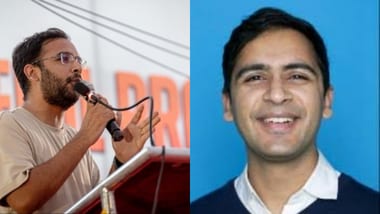
Former IIT Kanpur director Professor Indranil Manna has recalled a prolonged student agitation that put the institute’s administration under intense pressure, describing how Ashutosh Ranka, an alumnus who was then president of the Students’ Gymkhana, led the protests following a student’s death on campus
“He gave me a very, very tough time for three days and three nights in a row,” Manna recalled in an exclusive conversation with India Today, reflecting on the confrontation that took place around 2016-17.
The episode, according to Manna, became a test of his leadership as the institute’s director. Faced with demands from protesting students, he had to navigate the situation while deciding how the administration should respond to the death and the questions surrounding the medical assistance provided to the student.
His account has resurfaced at a time when student deaths and campus protests at premier institutions, including IIT Bombay and IIT Delhi, have renewed discussions about student welfare, faculty accountability and the responsibilities of institute administrations.
The agitation followed the death of a student who had complained of back pain after returning from the cricket field. According to Manna’s account, the student was taken to the institute’s health centre, where he was given a painkiller before being sent back to his hostel.
However, the student’s condition worsened. He subsequently began making his way back to the health centre but died before he could receive further assistance.
Manna was in Delhi when he learnt that a large number of students had gathered on campus to protest.
“I was in Delhi, away from the institute, when I heard that some 2,000 students had gathered at Henson. The students protested continuously that night and for another night and two days,” he was quoted as saying by India Today.
The demonstration soon became a major challenge for the institute’s leadership. Ranka, who headed the Students’ Gymkhana at the time, mobilised students and brought a large group to the director’s office to voice their demands.
Recalling the role played by the student leader, Manna said, “Ashutosh Ranka was the kind of president at IIT Kanpur who was responsible for putting me under pressure.”
Despite the pressure from the protesters, Manna said he did not give in to their demands. He maintained that the administration had to make decisions based on the facts of the case rather than the intensity of the agitation.
The Ministry of Human Resource Development (MHRD) subsequently constituted a committee headed by an AIIMS doctor to investigate the incident.
According to Manna, the doctor observed that the student’s ECG indicated a possibility of survival and acknowledged that the health-centre staff had conducted the test.
Manna recalled that, within ten days, Ranka and around ten other students returned to apologise after the committee had examined the matter.
The episode, he suggested, illustrated the importance of allowing an investigation to establish the facts before reaching conclusions or agreeing to demands made during a protest.
‘You should know how to deal with them’: Manna on handling student protests
Reflecting on his experience, Manna stressed that institutional heads must learn to handle student demonstrations without allowing pressure to dictate their decisions.
“You should know how to deal with them,” he said.
His argument was that listening to students and acknowledging their concerns did not necessarily mean accepting every demand put forward during an agitation. While student grievances deserve attention, he suggested, administrations must also consider the available evidence before deciding on a course of action.
Manna also recalled that he did not terminate the professor despite demands from the protesting students led by Ranka, who was then the Students’ Gymkhana president.