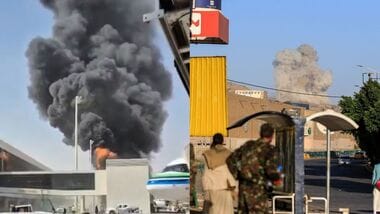
Tensions continue to rise in the after another attack by the Iran-backed Houthis on Saudi Arabia’s King Khalid International Airport in Riyadh on Sunday (local time), adding to instability in the already strained region.
The development comes amid a regional conflict that began in late February this year, when the and launched a joint operation against Iran, killing several senior leaders, including then-Supreme Leader Ayatollah Ali Khamenei. While Riyadh had largely avoided direct involvement in the conflict, the kingdom is now facing increased tensions as the Houthis step up their attacks.
1. On Sunday (local time), the Houthis launched another attack targeting Saudi Arabia’s King Khalid International Airport in Riyadh, killing one person and injuring 11 others. The attack came a day after 12 people were reported dead and over 300 were injured in an attack on the airport. A Saudi military spokesperson said the airport was struck by a projectile on 11 October, causing a fire in one of its passenger halls. In a statement on X, the kingdom’s civil aviation authority identified the person killed as a Pakistani resident.
2. Saudi-led coalition forces in Yemen said Riyadh’s air defences intercepted a cruise missile near the airport. They later added that a drone was intercepted and destroyed in the country’s Eastern Province, along with a ballistic missile launched towards Khamis Mushait. The Saudi Civil Defense said emergency alerts were also issued in Abha early on Monday, but the danger had since passed.
3. On 11 October, the Houthis renewed their warning against using Saudi airports. The group said, “We urge everyone to take our warnings seriously, and Saudi Arabia bears responsibility for any failed interceptions.” The warning came after the group said Riyadh had carried out at least 124 air strikes in Yemen over the previous 24 hours. Yemen’s Houthi-run foreign ministry added, “Unless the Saudi enemy stops its aggression and interference in Yemen, worse is yet to come, God willing,” Reuters reported.
4. The Houthis’ renewed attacks on Saudi airports come as the Middle East’s biggest economy prepares to host major events aimed at boosting foreign investment. The blast at Riyadh airport on 10 October brought to a near standstill, with most flights either cancelled or suspended. It also forced the capital’s financial hub to shift to remote work until further notice, while executives from BP and Shell were compelled to withdraw from a major energy event scheduled for this week.
5. On Sunday, the UK government advised against non-essential travel to Jeddah, Dammam and all Saudi airports other than . It also urged British nationals to consider leaving Saudi Arabia through land borders with neighbouring countries. Separately, the US Federal Aviation Administration (FAA) advised all US airlines on Sunday to exercise caution when flying into or over parts of Saudi Arabia “at all altitudes.”
6. As the Houthis continue to target airports in the kingdom, Saudi Arabia’s foreign ministry said Foreign Minister Prince Faisal bin Farhan Al Saud held a phone conversation with his Iranian counterpart, Abbas Araghchi, to discuss the latest regional developments and efforts to de-escalate tensions. According to Al Jazeera, the call was the first publicly reported contact between the two sides since the Houthis intensified their attacks against the kingdom.
7. India and the US were among the countries that denounced the attacks, expressed solidarity with Saudi Arabia and called for an end to strikes against civilians and civilian infrastructure. India’s Ministry of External Affairs (MEA) described the repeated attacks as unacceptable and demanded an immediate halt.
US Secretary of State Marco Rubio said the Houthi strikes reflected a “blatant disregard for innocent civilian life” and reiterated Washington’s support for Saudi Arabia. Meanwhile, US President said his administration was weighing whether to participate in Saudi strikes against the Houthi rebels.
(with agency inputs)