



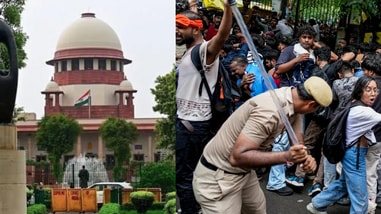
The has issued contempt notices over allegations that authorities violated its October 9 order on restrictions imposed during the Delhi protests, including the closure of metro stations and the detention of thousands of demonstrators. The court said the applicants had established a prima facie case of contempt and directed the alleged contemnors to submit counter-affidavits and a compliance report by October 13.
The Supreme Court also issued notice in a habeas corpus petition alleging the . Police on Saturday, detained at least 7,000 protesters in Delhi and Mumbai. CJP leader Abhijeet Dipke, Ashutosh Ranka, Sourav Das were detained by Delhi Police right from inside the Air India flight they had arrived at Delhi in.
Poiliticians were alo put under houe arrest pr detained. Four former Chief Minister including Mamata Banerjee, Pinarayi Vijayan were detained.
It has, for now, dispensed with the personal appearance of those facing the contempt allegations.
The urgent hearing followed applications claiming that transport services had been disrupted, movement across Delhi restricted and people detained beyond the areas covered by prohibitory orders during demonstrations on October 10. The entry and exit gates of at least 45 Delhi Metro station were shut on Saturday. Further, trains arriving at Delhi’s Nizammuddin station were also cancelled from 4am to 2pm.
Howrah and Sealdah Rajdhani were also cancelled on 9 October.
During the hearing, lawyers argued that authorities had failed to comply with the Supreme court’s October 9 directions. Their submissions alleged that Delhi metro services had been disrupted, New Delhi and Nizamuddin railway stations had remained closed, traffic advisories had not been issued and internet services had been suspended.
The petitioners also said that the restrictions created a curfew-like atmosphere across Delhi, causing hardship to residents, professionals and protesters.
Advocate Menaka Guruswamy, appearing for the petitioners, referred to claims that GTB Nagar and Vishwavidyalaya metro stations, among others, had been shut to the public in violation of the apex court’s directions.
Guruswamy also argued that the habeas corpus petition raised concerns about the detention of approximately 7,000 people, extending beyond the individuals named in the petition.
Solicitor General Tushar Mehta disputed the allegations, telling Supreme Court that the Delhi Metro had continued to operate normally, although 45 of its 303 stations had been closed to maintain law and order.
Notably, the gates of these 45 Delhi metro stations were opened only after 10pm on Saturday.
Responding to the habeas corpus petition, Mehta denied that anyone had been illegally detained and argued that the petition had become infructuous because the individuals concerned had been released.
Tushar Mehta also informed the court that internet services had been restored and all metro stations were functioning normally from 10 pm the previous night. Mehta assured the court that lawyers, journalists and other professionals would not be obstructed while carrying out their duties.
The court, however, said the allegations warranted consideration and issued notices to the alleged contemnors. They must file their responses and a compliance report by October 13.
The apex court reiterated that public transport could be regulated when necessary to maintain law and order, but should not be prohibited outright. Its had called for authorities to reconsider the closure of 57 metro stations and ensure that decisions on transport restrictions were widely publicised.
It had also directed authorities to issue traffic advisories through newspapers and online platforms to minimise inconvenience to the public.
In its latest directions, the Supreme Court said metro trains and railway facilities must operate normally unless regulation was necessary under reasonable restrictions envisaged by Article 19(2) of the Constitution. It also directed Delhi authorities to review road barricades to facilitate movement, subject to law-and-order and traffic requirements.
Supreme Court further ordered that internet services function without hindrance in Delhi, and that peaceful, unarmed protesters should not face illegal detention beyond areas where Section 163 of the Bharatiya Nagarik Suraksha Sanhita (BNSS) was in force.
Thedirected authorities to remove a notice board stating that Section 163 had been invoked within the Supreme Court premises, if it had not already been taken down, to prevent apprehensions about access to the court and other judicial institutions.
The court also reiterated that lawyers, journalists and other professionals must be allowed to perform their duties without obstruction.
The contempt proceedings and habeas corpus petition will be considered further on October 13, alongside other applications concerning the restrictions imposed during the protests.
The latest order follows demonstrations against Chief Election Commissioner Gyanesh Kumar over alleged irregularities in the Special Intensive Revision of electoral rolls. The protests led to extensive security arrangements and mass detentions as demonstrators attempted to reach Jantar Mantar.
(The article was written from the Supreme Court’s 11 October order shared by LiveLaw)