


The Supreme Court is convening a special Sunday sitting today, October 11, to address urgent legal challenges arising from the sweeping transit restrictions and preventive detentions enforced during the Cockroach Janta Party (CJP) protests in New Delhi.
A special Bench comprising Justices Joymalya Bagchi and V Mohana will assemble at 10:30 AM to hear the matters, according to legal news portal Bar & Bench.
Here is everything you need to know about today’s special hearing and the events leading up to it:
The primary focus of today’s hearing is a contempt of court petition alleging that authorities wilfully disobeyed the Supreme Court’s prior directives.
Advocate Shailendra Mani Tripathi filed the plea seeking contempt proceedings against Union Home Secretary Govind Mohan, Delhi Police Commissioner Anurag Kumar, and Delhi Metro Rail Corporation () Chairperson D Thara.
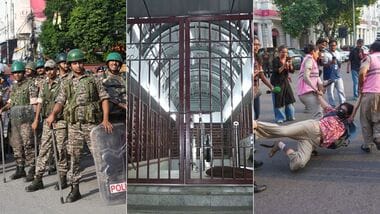
According to Bar & Bench, the petition contends that despite the Court’s October 9 order advising against a blanket shutdown of public transport, the DMRC closed entry and exit gates at 45 metro stations.
Tripathi claimed that he personally verified these closures at the GTB Nagar and Vishwavidyalaya stations on the night of October 9.
The plea argued that this “deliberate recalcitrance” severely crippled public life in the national capital and stranded essential travellers, with no adequate .
According to a LiveLaw report, a contempt of court petition has been filed in the Supreme Court against Delhi Police Commissioner Anurag Kumar.
The petition alleged that personnel under his command resorted to “indiscriminate violence” against unarmed citizens during the October 10 demonstrations at .
The petitioner contended that these actions explicitly violated the principles of minimum force and proportionality previously outlined by the Supreme Court. According to the allegations detailed by LiveLaw, the police detained and assaulted multiple unarmed individuals during the demonstration.
The petition also claimed that participating officers were operating without name tags and that several women protesters were manhandled by male officers during the crackdown.
In tandem with the transport issues, the Bench will hear a petition challenging the sweeping police action against political figures and citizens.
Trinamool Congress MP and Senior Advocate Menaka Guruswamy has approached the top court challenging the preventive detention of opposition party leaders, including four former Chief Ministers who were participating in the protests.
According to Bar & Bench, Guruswamy argued that preventive detention cannot be weaponised to suppress the fundamental right to peaceful protest. Her plea also highlights alleged police excesses against legal professionals, bringing focus to the detention of lawyers, including Senior Advocate Shadan Farasat.
Today’s contempt plea directly stemmed from a hearing on Friday, October 9.
A Bench led by Chief Justice of India Surya Kant, alongside Justices Bagchi and Mohana, reviewed earlier petitions regarding the transit curbs ahead of the CJP’s demonstration demanding the resignation of Chief Election Commissioner Gyanesh Kumar.
During that hearing, the Court criticised the widespread closures of metro stations and the cancellation of over 200 trains.
According to a report by The Indian Express, the Bench reminded authorities of the “principle of proportionality,” stating that while law enforcement can take steps to manage unruly crowds, “it does not mean that you will use a hammer to kill a fly.”
The Court had directed the government to ensure there was no “complete prohibition” on movement, recording an assurance from Solicitor General Tushar Mehta that the restrictions would be reconsidered.
According to a recent Hindustan Times report, CJI Surya Kant recently defended the Court’s decision to invoke Article 142 of the Constitution to quash FIRs against student protesters involved in earlier Jantar Mantar demonstrations.
Refusing to order an independent probe into those protests, the CJI noted the need to protect the futures of the young students involved, stating, “We have to see their parents, their future. We don’t want them to come to court.”