


Indian consumers remain keen to buy, spend and travel during the upcoming festive season, but anxiety about family finances is acting as a dampened on high ticket discretionary spending, a latest nationwide survey has concluded.
Lower income families are deeply worried about their financial conditions while upper income families remain optimistic, the conducted ahead of festive season indicates.
The survey’s most striking finding is the extent of financial anxiety among Indian households. More than half of respondents, or 53.6%, said in the survey that their family’s financial condition was worse than it was a year ago. Only 11.6% reported an improvement, while 27.1% said their situation remained unchanged, the survey said.
The CVOTER survey, conducted on 28–29 September 2026 among 2,051 respondents, captures consumer purchase and spending intentions across clothing, household appliances, electronics, vehicles and jewellery, home renovation, festive shopping, payment preferences, shopping channels and travel.
Centre for Voting Opinions and Trends in Election Research, or CVoter, is an Indian headquartered in Delhi.
The urban-rural divide is equally telling. While 40.6% of urban respondents reported worsening finances, the proportion rose to 59.2% among rural respondents.
The outlook for the coming year offers little indication of a broad-based recovery in consumer confidence. Only 24.4% expect their household finances to improve, while 38% anticipate a deterioration. Another 24% expect their financial condition to remain unchanged, and 13.6% are unsure.
The strain is particularly pronounced among lower-income households. As many as 63.2% of respondents in the (LIG) said their financial condition had deteriorated, compared with 26.3% among those in the higher-income group (HIG).
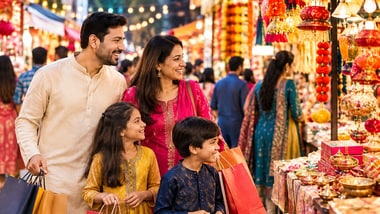
Despite financial concerns, traditional festive purchases remain on the agenda for many households. For centuries, buying new clothes is a key family activity every festive season.
Around 45% of respondents said they had already bought or planned to buy new clothes for at least one family member. Of these, 16.9% intended to purchase clothes for the entire family, 20.4% specifically for children, 6.2% for themselves and 4.8% for other family members.
However, 45.4% said they did not plan to buy new clothes, underlining the restraint affecting household budgets.
Traditional sweets also appear to have an advantage over chocolates. Nearly 33% of respondents say they are most likely to buy sweets from a local sweet shop, while another 8.7% intend to buy both sweets and chocolates. This gives traditional sweets a substantially larger role than imported chocolates, which are mentioned by only 3.1%. account for another 4.3%. This indicates a vocal for local sentiment.
The findings suggest that festive spending is continuing, but households are prioritising familiar purchases over less essential indulgences.
are wary when it comes to larger purchases.
Only 21.5% of respondents said they had already bought or planned to buy kitchen appliances, while 18.5% reported the same for electronic items. Around 22% mentioned plans involving a two-wheeler, a car, gold or jewellery, or more than one of these categories, the survey said.
Home improvement projects are also seeing mixed demand. Around 39% said they had already renovated their homes or planned to do so, including 14.6% who had completed the work and 24.5% who intended to undertake it, according to the survey. Half of the respondents, or 50.2%, said they had no plans for painting, distempering or other renovation work.
Payment preferences further illustrate the cautious mood. While 32.2% planned to pay in full at the time of purchase, 12.8% expected to use (EMIs) or other instalment options. Another 14.7% said they might combine full payment with instalments. Also, 32.1% said they were not planning any major purchase.
The findings indicate that financing options remain relevant for consumers making large purchases while a substantial share of households are choosing to avoid such expenditure altogether.
Travel continues to be another important part of the festive season, although a significant share of households are staying put.
Around 47.5% of respondents said they were considering a family holiday or trip. Local or nearby destinations accounted for 15.7%, while 15.1% planned a religious or pilgrimage trip, according to CVoter survey.
Another 5.1% intended to travel to another state, 1.7% were considering an international trip and 5.3% had plans but had yet to decide on a destination. At the same time, 47.5% said they were not planning a family trip.
The figures suggest that festive travel demand is likely to be concentrated on domestic, nearby and religious destinations rather than international holidays.
-53.6% say their family’s has worsened over the past year.
-More than 35% plan to spend less this festive season than they did last year, while fewer than 10% expect to spend more.
-45.4% do not plan to buy new clothes for the family.
-52.1% prefer shopping at local or nearby markets, while just 5.6% favour online shopping.
-47.5% are considering a family trip, with domestic and religious destinations leading the choices.