



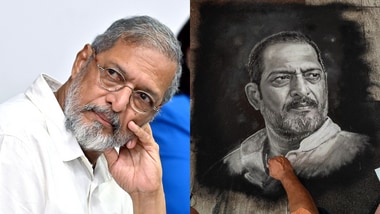
Veteran actor Nana Patekar’s last rites were held at around 11.30 PM on Thursday, 8 October, at his family farmhouse in Donje village near Pune. His son, Malhar Patekar, has explained that the late-night cremation followed delays in bringing the actor’s mortal remains from .
Patekar, 75, died early on Thursday after suffering a cardiac arrest at his residence in Goa. He was cremated with full state honours at the family property, known as Nanachi Wadi, later that night.
Speaking to news agency ANI after the funeral, said the family had expected his father’s remains to reach the farmhouse earlier. The journey took longer than anticipated, however, and the family decided to proceed with the last rites on the same day.
“We expected it to arrive earlier, but it took us some time,” Malhar said, explaining that several hours had already passed since his father’s death. The family therefore chose not to delay the cremation further.
Beyond explaining the timing of the funeral, Malhar spoke about the values his father had carried through his life and the work he had entrusted to others.
“A person like Nana Saheb never truly leaves us. Through their work, they become immortal,” he said, reflecting on the actor’s enduring influence.
Malhar recalled his father’s repeated appeal to people to come together in the name of humanity and work towards a better world. He said initiatives in were already under way through their organisation, while larger projects in education and healthcare had begun in . His father, he added, had assigned responsibilities to people before his death.
Nana Patekar has spent more than four decades carving out a distinct place for himself in , moving between Hindi and Marathi films, theatre and filmmaking. Known for his intense screen presence and unpredictable performances, he has often taken on characters that sit far outside the mould of a conventional hero.
His career has been shaped by roles that are raw, complex and, at times, deeply unsettling.
Patekar made his film debut with Gaman in 1978, but it was his performance in Parinda (1989) that brought him wider recognition. Playing a ruthless gangster, he portrayed a character who was menacing yet vulnerable, earning the National Film Award for Best Supporting Actor.
He followed this with another landmark performance in Krantiveer (1994), in which he played a disillusioned man who finds himself drawn into a fight against corruption. The role won him the and remains among the most memorable performances of his career.
His ability to move between challenging dramatic roles and mainstream entertainment continued to define his filmography. He won a third National Film Award, this time for Best Supporting Actor, for Prakash Jha’s Apaharan (2005). Other notable films include Prahaar: The Final Attack, Angaar, Khamoshi: The Musical, Yeshwant and Ab Tak Chhappan.
He also showed a lighter side in Bluffmaster! and , reaching audiences who knew him primarily for his intense, often hard-edged performances.
Marathi cinema has remained an important part of Patekar’s career. His performance in Natsamrat (2016), adapted from the celebrated play, showcased a different kind of intensity.
Patekar also stepped behind the camera to direct Prahaar, further expanding his role in filmmaking. His contribution to Indian cinema was recognised with the in 2013.
Beyond films, Patekar has been associated with social work, particularly efforts to support rural communities affected by drought. In 2015, he co-founded the Naam Foundation with fellow Marathi actor Makarand Anaspure. The organisation works with drought-hit and rural communities, focusing on water conservation and sustainable development.