


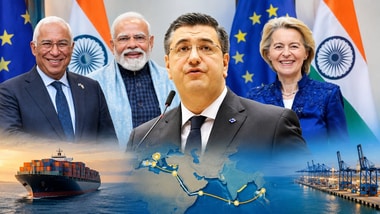
The European Union has backed the India-Middle East-Europe Economic Corridor (IMEC) to diversify trade routes and make India-Europe connectivity more resilient, with Apostolos Tzitzikostas, European Commissioner for Sustainable Transport and Tourism, warning that global trade cannot depend on a single maritime route, port or chokepoint.
Tzitzikostas made the remarks at the ‘Sagarmanthan: The Great Oceans Dialogue 2026’ event being held from 7 to 9 October in New Delhi, amid renewed concerns over disruptions to global shipping through the Strait of during the Iran war.
“We cannot afford to depend on a single route, a single port or maritime chokepoint,” Tzitzikostas said on the opening day of the forum on Wednesday. “When one is disrupted, the consequences extend to factories, energy markets, supply chains and eventually citizens and their everyday lives.”
The IMEC is a planned multimodal connectivity project announced on 9 September 2023, during the in New Delhi.
The crisis around the Strait of Hormuz amid the war in Iran has renewed attention to the IMEC, highlighting the need for alternative trade and transport routes linking India with Europe.
Tzitzikostas, while addressing a session on the India-EU Green Shipping Corridor: Innovation, Action and Scale, said could help diversify connectivity between India and Europe by creating a network of interconnected transport, energy and distribution links.
He emphasized that ports and maritime connections would be central to the corridor, while the EU’s Global Gateway initiative could help turn the IMEC vision into sustainable and resilient infrastructure projects.
Recent disruptions have shown how quickly conflict, piracy, organized crime and threats at sea can affect global trade, Tzitzikostas said.
“Europe and India are natural maritime partners. The ocean connects our economies and our societies. Our are gateways to trade, energy and industrial value chains,” he said.
Tzitzikostas highlighted the potential for India and Europe to cooperate on sustainable maritime fuels.
“Europe is creating a very strong demand for sustainable maritime fuels,” he said.
He said that India has significant renewable-energy potential and could become a major producer of green hydrogen derivatives such as green ammonia and methanol.
“Europe can provide India a growing market, technology and investment. This complementarity gives our partnership real potential,” he said.
Tzitzikostas said green shipping corridors can turn climate ambitions into concrete investments by bringing together ports, fuel producers, shipping companies and customers, with government support.
“The priority now is implementation: credible projects, sustainable fuel supply, bold infrastructure, and trusted standards and certifications,” he said.
The EU official said sustainable shipping, resilient connectivity, maritime security and healthy oceans should form the four pillars of India-EU maritime cooperation.
Tzitzikostas said recent disruptions have demonstrated the vulnerability of global maritime trade to security threats.
“It makes absolute sense for us to deepen our cooperation on maritime security, including port and ,” he said.
He also stressed the importance of establishing a global framework for shipping that is workable, enforceable and pragmatic, while providing investors with certainty and supporting zero- and near-zero-emission shipping.
Tzitzikostas described India as one of the world’s three major maritime nations and a major source of seafarers, saying India’s voice would therefore be important in shaping global maritime rules.
“Our task now is to turn political ambition into concrete results: cleaner seas, more sustainable ports, safer rules and stronger global rules for our oceans,” he added.