



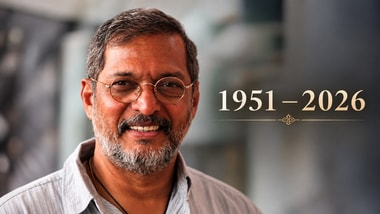
There was rarely anything understated about on screen. His unmistakable voice, sharp expressions and intense performances could turn even a few lines of dialogue into a memorable cinematic moment.
Veteran actor Nana Patekar, one of the most recognised performers in Hindi and Marathi cinema, died on Thursday at the age of 75 after suffering a severe at his residence in .
Patekar was reportedly found unconscious at his home in Dona Paula and was rushed to Manipal Hospital, where he was declared dead at 5:20 am. Doctors attempted to revive him for around 45 minutes but could not revive him.
Dr Shekhar Salkar, Chief of the Oncology Department at Manipal Hospital, confirmed the actor’s death to news agency ANI and said that a medico-legal case had been registered. A post-mortem examination will also be conducted.
With a career spanning decades, Patekar left behind a filmography that moved from intense dramas and crime thrillers to mainstream comedies, while also establishing a significant body of work in Marathi cinema.
Patekar’s Bollywood journey began with the 1978 film Gaman. It was through a succession of challenging roles, however, that he established himself as a performer capable of bringing considerable intensity to the screen.
His performance in Parinda earned him the National Film Award for Best Supporting Actor. He followed that with a National Film Award for Best Actor for Krantiveer.
The actor subsequently delivered acclaimed performances in films including Agni Sakshi, Khamoshi: The Musical, Ab Tak Chhappan and Apaharan.
These films showcased the range that would become central to his career. Patekar could play volatile, morally complex and intimidating characters without relying on conventional Bollywood heroics.
For all the intensity associated with Patekar, one of his most enduring popular characters came from comedy.
In Welcome (2007), Patekar played gangster Uday Shetty, bringing a combination of menace and comic timing to the role. The character became one of the most memorable comic performances of his later career.
He returned as Uday Shetty in Welcome Back (2015), once again sharing the screen with an ensemble cast in a very different setting from the intense dramas that had defined much of his earlier work.
The role also demonstrated that Patekar could move into mainstream comedy without losing the distinctive screen presence that had become his trademark.
Patekar continued to gravitate towards characters with shades of grey and complicated motivations.
In Ab Tak Chhappan, he played a police officer, while Apaharan allowed him to explore another layered role within a crime drama.
His performances often depended as much on pauses, expressions and body language as they did on dialogue. This became one of the defining characteristics of his acting style.
While Patekar became a familiar face to Hindi film audiences, Marathi cinema remained an important part of his career.
In 2016, he won the Filmfare Award for Best Actor for his performance in the Marathi film Natsamrat.
His work across Hindi and Marathi cinema allowed him to move between mainstream productions and performance-led films without being restricted to one particular kind of role.
Patekar’s involvement with cinema extended beyond acting. He directed Prahaar: The Final Attack and was also involved in writing and filmmaking.
He was also known for playback singing, lending his voice to songs in films including Yeshwant (1997), Wajood (1998) and Aanch (2003).
Over the course of his career, he won three National Film Awards and four Filmfare Awards, besides Maharashtra State Film Awards and other honours.
In 2013, he was conferred the Padma Shri for his contribution to cinema and the arts.
Patekar married Neelkanti Patekar in 1978. The couple had two sons, Durvasa and Malhar. Their elder son, Durvasa, died at a young age due to illness.
Nana and Neelkanti later lived separately for several years due to personal differences, although they remained legally married.
Patekar was also associated with social causes and had a connection with rural Maharashtra. He remained involved in efforts aimed at supporting farmers and people affected by difficult circumstances.
Patekar’s career cannot easily be reduced to one image.
He could be the intense protagonist of Krantiveer, the complex police officer of Ab Tak Chhappan, the intimidating presence in a crime drama or the comic Uday Shetty in Welcome.
What remained consistent was the individuality he brought to every performance.
He did not fit the conventional mould of a Bollywood leading man. His performances were instead driven by his voice, body language, expressions, silences and an intensity that could change the mood of a scene.
From Parinda and Krantiveer to Ab Tak Chhappan, Natsamrat and Welcome, Nana Patekar’s career crossed genres, languages and generations.
His films leave behind a collection of characters that audiences remember—not simply for the roles themselves, but for the unmistakable stamp Patekar brought to them.