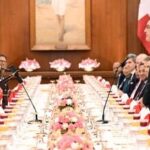



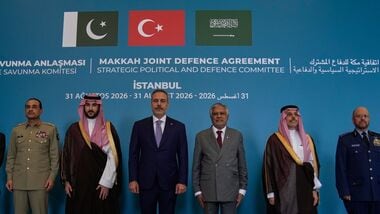
Saudi Arabia, Pakistan and Turkey moved to activate their Makkah Joint Defence Agreement on Monday (6 October), announcing steps to prepare and deploy military forces and defence assets to Saudi Arabia amid renewed Houthi attacks and escalating regional tensions.
The move followed emergency talks in Riyadh on Monday involving senior political and military officials from the three countries.
Following the talks, Khalid bin Salman announced the pact’s activation, and Pakistan also issued an official statement.
The development has put a spotlight on the 7 August Makkah defence agreement, often described as a potential “Muslim NATO” because of its collective-defence clause.
But analysts caution that the comparison with NATO may be overstated.
The agreement is modelled in part on NATO’s Article 5 principle, under which an armed attack against one member is treated as an attack against all.
However, the pact does not automatically make Saudi Arabia, Pakistan and Turkey a -style military alliance.
A UK-based think tank, the Centre for International Security and Economic Strategy (CISES), argues that calling the agreement a “Muslim NATO” is misleading because the three countries have different strategic priorities and threat perceptions.
However, the three countries had agreed to establish a permanent secretariat in , initially headed by a Pakistani secretary-general, alongside greater defence cooperation, military cohesion and joint industrial and technological development.
The biggest challenge for the pact is that Saudi Arabia, Turkey and Pakistan do not necessarily see the same countries as their primary threats.
Saudi Arabia: Riyadh’s main security concern is Iran and the Iran-backed Houthis. Saudi Arabia is balancing its security relationship with the US while deepening ties with China and managing its rivalry with Tehran.
Turkey: Ankara has a more multidirectional threat perception, including tensions involving Israel, Kurdish armed groups and its wider regional interests. Turkey is also a NATO member while maintaining relations with Russia, including through its purchase of the S-400 air-defence system.
Pakistan: Islamabad considers India its principal security concern while also maintaining strategic relationships with China, the US and Gulf states. It also faces security challenges linked to the Taliban in Afghanistan.
CISES notes that emerged in a very different environment. In 1949, the Soviet Union provided a powerful common threat that helped bind otherwise different states together.
According to CISES, all three countries have pursued a hedging strategy, preserving room for manoeuvre rather than committing themselves exclusively to one power or bloc.
An attack that appears existential to one member could be viewed differently by the other two.
CISES points to Iran as an example: while Iran is a major security concern for Saudi Arabia, Turkey maintains functional ties with Tehran, including energy and trade relations. Pakistan, meanwhile, shares a border with Iran and cannot simply view Tehran through the Saudi security prism.
This means an attack on one member could produce very different strategic calculations for the other two.
Even own Article 5 does not prescribe one specific military action. Each member determines the form of assistance it considers necessary.
The distinction is important because the “” label could create expectations of automatic military mobilization that the pact may not actually guarantee.
CISES points out that Pakistan’s statement on the indicated a commitment to collective defence, but no military response under the pact had been discussed.
The agreement should therefore not be dismissed simply because it is not , the think tank notes.
Its institutionalization could create a platform for intelligence sharing, defence-industrial cooperation, technology development and greater military coordination among the three countries.
The establishment of a permanent secretariat and commitments to military cohesion and joint industrial and technological development suggest that the members are seeking greater organizational substance.
But CISES cautions that expecting, Turkey and Pakistan to behave like NATO’s highly committed allies could create dangerous expectations during a crisis. If one member assumes Article 5-style solidarity while another is still weighing its options, the resulting expectation gap could itself create strategic miscalculations.
The activation of the Makkah pact amid renewed Houthi attacks is its first major test.
For now, “” may be a catchy label, but the strategic reality is far more complicated.
The immediate backdrop to the activation is the renewed escalation involving Yemen’s Iran-aligned Houthis.
The conflict goes back to the broader war in Yemen. The Houthis seized large parts of Yemen, including Sanaa, in 2014. Saudi Arabia intervened militarily in 2015 to support Yemen’s internationally recognized government and push back the Houthis, although fighting eased following a UN-brokered truce in 2022.
Tensions have risen again as Saudi-backed Yemeni forces seek to regain territory from the Houthis, prompting missile and drone attacks targeting Saudi Arabia. The Houthis have also attacked shipping in and around the Red Sea as part of their wider regional campaign.
(With inputs from agencies)