


British Airways flight BA295 returned to Heathrow after a cabin pressure problem on 5 October. The Boeing 777-200ER was flying from London to Chicago when trouble developed over Ireland.
Flight tracking showed a descent from 36,000 feet to 9,000 feet in roughly 7 minutes. The crew issued emergency code 7700 and turned back towards London. Descending helped the aircraft reach a height where additional oxygen was no longer required. It landed safely at Heathrow.
The incident reminds us of 5 earlier emergencies, involving damaged aircraft, intrusions and engine failures. Take a look.
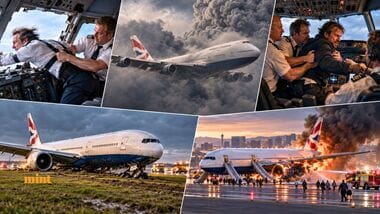
On 10 June 1990, Flight 5390 departed Birmingham for Malaga. Around 13 minutes later, the windscreen blew out while climbing over Oxfordshire.
The BAC One-Eleven was at about 17,300 feet when the cabin suddenly lost pressure. Captain Tim Lancaster was pulled partly through the cockpit window. Flight attendant Nigel Ogden grabbed his legs while colleagues helped hold him securely.
Co-pilot Alastair Atcheson landed the British Airways at Southampton despite fierce wind and noise. Lancaster survived frostbite, fractures and shock. Everyone aboard survived. The windscreen had been fitted using bolts that were slightly too small.
On 24 June 1982, Flight 009 was travelling from Kuala Lumpur to Perth. Its Boeing 747 entered volcanic ash from Indonesia’s Mount Galunggung.
The ash damaged cockpit windows and caused all four engines to stop working. The aircraft lost height while fumes entered the cabin.
After leaving the ash cloud, the crew restarted three engines. They landed at Jakarta’s Halim Perdanakusuma airport despite damaged windows. All 263 people aboard survived.
On 29 December 2000, Flight 2069 was travelling from London Gatwick to Nairobi. A passenger forced his way into the Boeing 747’s cockpit at 35,000 feet.
He interfered with the controls, causing a steep descent of around 6,000 feet. Passengers were thrown around, and several suffered injuries.
Captain William Hagan, First Officer Phil Watson and others overpowered the intruder. The crew regained control, and the British Airways flight landed safely in Nairobi.
On 17 January 2008, Flight 38 approached Heathrow after travelling from Beijing. Its Boeing 777 suffered power problems in both engines at around 600 feet.
The aircraft landed hard on grass before Runway 27L. Its landing gear collapsed, and the aircraft suffered severe damage.
Investigators linked restricted fuel flow to ice in the equipment, exchanging heat between fuel and oil. The crew cleared the airport’s perimeter fence before landing. All 152 occupants survived, and passengers were evacuated.
On 8 September 2015, Flight 2276 prepared to depart Las Vegas for London Gatwick. Its Boeing 777 suffered a major left-engine failure during the takeoff run.
Engine debris damaged fuel tanks, triggering a fire around the left wing and aircraft body. The pilots stopped the takeoff, and crew members evacuated everyone using emergency slides.
The flight carried 170 passengers and crew. Minor evacuation injuries were reported while firefighters prevented a larger disaster.