


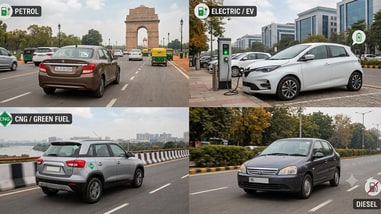
Delhi-NCR has a revised Graded Response Action Plan (GRAP) for the 2026 winter pollution season, with the Commission for Air Quality Management (CAQM) tightening several measures covering vehicles, construction and pollution sources. Among the key changes is the extension of restrictions on certain petrol and diesel cars to Sonipat.
The revised framework contains 48 actions across four stages, with some restrictions brought into force at an earlier stage and certain exemptions removed.
The restrictions on certain private cars come into force under Stage III. At this stage, BS-III petrol and BS-IV diesel light motor vehicles (four-wheelers) face plying restrictions in Delhi and the high-vehicle-density districts of Gurugram, Faridabad, Ghaziabad, Gautam Buddh Nagar and Sonipat.
Sonipat is the latest addition to this list; the restriction earlier covered the other four NCR districts.
The restriction is based on the vehicle’s Bharat Stage emission category, rather than simply its registration year or age.
The Stage III provision specifically covers and BS-IV diesel four-wheelers. BS-VI private cars are therefore not covered by this particular plying restriction.
Other GRAP measures can, however, apply separately to different categories of vehicles, including buses and goods vehicles.
and electric private cars are not included in the Stage III restriction covering BS-III petrol and BS-IV diesel four-wheelers.
This is specific to the private-car restriction. Other applicable requirements, including valid pollution-control documentation where required, continue to apply.
The revised GRAP has removed the earlier exemption for BS-IV and below goods vehicles carrying essential commodities under Stages III and IV.
Under Stage III, restrictions apply to specified BS-IV and below light and medium goods vehicles, while Stage IV contains restrictions covering trucks and heavy goods vehicles. The revised schedule also clearly provides for restrictions on the entry into Delhi of diesel BS-IV and below light and medium goods vehicles registered outside Delhi.
Restrictions on certain inter-city and inter-state buses have been moved from GRAP Stage II to Stage I, meaning they will kick in earlier when pollution levels rise.
Under Stage I, buses from Haryana, Uttar Pradesh, Rajasthan and adjoining states, including Punjab, Himachal Pradesh, Madhya Pradesh, Uttarakhand and Jammu and Kashmir, will not be permitted to ply in Delhi-NCR unless they are electric, CNG or BS-VI diesel.
The move expands the earlier restriction, which applied at Stage II and covered a narrower set of states.
has also amended Directions 11 to 18, originally issued in 2021, which deal with monitoring and dust-control measures at construction and demolition (C&D) sites in the NCR.
The existing provisions include online registration and monitoring of eligible C&D projects, with the threshold of plot areas of 500 square metres or more remaining unchanged.
The major change is the expansion of these provisions beyond urban local body or municipal limits. They now cover eligible projects in urban areas, controlled areas, development areas or industrial development areas, industrial areas or zones, and highway corridor zones in NCR states, as applicable under the relevant planning frameworks.
CAQM has strengthened monitoring of construction and demolition (C&D) activities as part of its wider effort to control dust pollution. The revised directions extend the existing web-portal registration and monitoring mechanism to eligible projects located beyond municipal limits.
CAQM member SD Attri said the commission plans to make it mandatory for construction and demolition sites measuring more than 500 square metres to display PM10 and PM2.5 levels so that pollution concentrations can be visible to the public, according to the Times of India.
Restrictions on diesel generator sets and the entry of certain BS-IV and below buses have been moved from Stage II to Stage I, bringing these measures into effect earlier during air quality deterioration.
The revised schedule also consolidates several repeated provisions concerning dust control, municipal solid waste management and transport under Stage I. A limited relaxation has been introduced under Stage III for certain pothole-repair work despite the restrictions on construction and demolition activities.