



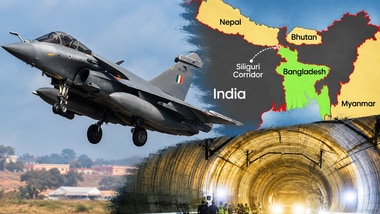
India is stepping up efforts to fortify the strategically vital Siliguri Corridor, popularly known as the “Chicken’s Neck”, with plans for underground military infrastructure, hardened command and ammunition facilities, stronger air-power capabilities and alternative connectivity routes to the Northeast.
The corridor, located in northern is just over 22 km wide at its narrowest point and serves as the crucial land link between mainland India and the northeastern states. Wedged between Nepal and Bangladesh, with Bhutan and China nearby, the corridor is among India’s most strategically vulnerable areas.
India is planning a 40-km underground railway corridor through the Siliguri Corridor to ensure secure and uninterrupted connectivity with the Northeast, Union Railway Minister Ashwini Vaishnaw said.
The proposed underground link aims to create a more resilient transport route through an area that could face disruption in the event of a military conflict.
India is also looking to move key below ground in the strategically sensitive corridor.
According to a CNN-News18 report, the Army plans to establish 12 underground ammunition storage facilities for air-defence units, along with underground storage for ammunition used by the Smerch long-range rocket system.
The plans also include 21 surface firing positions, five underground command centres, six communication centres and 12 bomb shelters, the report said.
Headquarters is also planning new military stations along the corridor, according to the report.
The underground infrastructure is intended to improve the survivability of critical military assets against missile strikes and other attacks during a conflict.
The Air Force Station in West Bengal forms another key component of India’s defence posture around the corridor.
Located close to the strategic area, Hasimara is home to the Indian Air Force’s No. 101 Squadron, known as the “Falcons of Chhamb and Akhnoor”, which operates Rafale fighter jets.
The squadron was formally operationalised at in July 2021, giving India a potent air-power asset close to one of its most strategically sensitive regions.
The Siliguri Corridor is the principal land connection between the rest of India and the Northeast.
Any major disruption to the corridor could affect the movement of troops, fuel, food, military equipment and other essential supplies to the region.
Its vulnerability has also prompted India to explore alternative connectivity routes through and Myanmar, reducing dependence on a single narrow land link.
India’s concerns over the corridor were underscored by the 2017 standoff, when Indian and Chinese troops faced off for more than two months after China increased its military presence in the Doklam area near the India-Bhutan-China trijunction.
China’s infrastructure development in the region, including roads and military facilities, has remained a major concern for Indian security planners.
The proximity of Doklam to the Corridor adds to the strategic importance of maintaining secure access to the Northeast.
Alongside fortifying the corridor, India is expanding infrastructure that could provide more resilient connectivity across the Northeast.
The Cabinet Committee on Economic Affairs has approved a ₹18,662-crore project for four-lane, access-controlled greenfield connectivity between Gohpur on NH-15 and Numaligarh on NH-715 in Assam.
The project includes a 15.79-km road-cum-rail tunnel beneath the Brahmaputra, which the government has described as India’s first underwater road-cum-rail .
The project is expected to improve connectivity to , Arunachal Pradesh, Nagaland and other northeastern states while reducing travel time and improving freight movement.
It also aims to lower logistics costs and support economic growth across the region.
India is also strengthening its infrastructure that can support military operations during emergencies.
In February, Prime Minister Narendra inaugurated an emergency landing facility in Dibrugarh, Assam. The 4.2-km stretch of highway has been upgraded to allow military aircraft to land during emergencies.
India has also decided to establish a military base in near the Bangladesh border, adding another layer to its security architecture in the Northeast.
Taken together, the measures reflect a broader strategy: fortifying the Siliguri Corridor itself, building underground military infrastructure, strengthening air power, and creating alternative transport links so that the Northeast is not dependent on a single vulnerable gateway.