


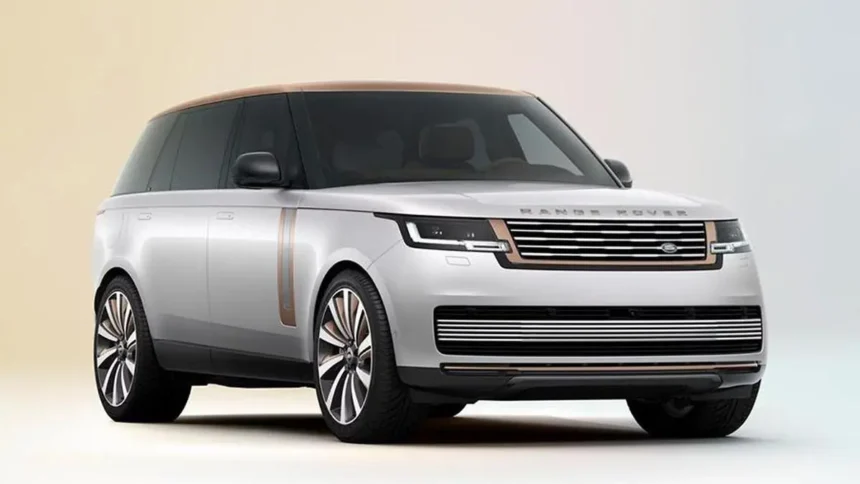
Jaguar Land Rover has opened India bookings for the Range Rover Sport Electric, taking battery power into one of its most important luxury SUV franchises as the Tata Motors-owned carmaker attempts to build the scalable electric-vehicle business that its pioneering I-PACE never became.
“Excited to share the Range Rover Sport Electric is now available to order,” Balaje Rajan, JLR’s Group Chief Strategy Officer, said. The vehicle, he said, brings together “world-class hardware and software”, with digital technologies enhancing performance, efficiency, charging and the ownership experience.
The Sport Electric is designed to address three gaps left by the I-PACE: manufacturing scale, an electrical architecture that could keep pace with newer rivals, and a route to electrifying the Range Rover SUVs that increasingly dominate JLR’s business. It is assembled at Solihull in UK, moves from the I-PACE’s 400V system to an 800V architecture, and puts JLR’s latest electric technology into a core Range Rover rather than a standalone Jaguar.
The I-PACE put JLR among the early luxury EV entrants when it arrived in 2018, but it remained largely an island. Production was contracted to Magna Steyr in Austria, and the car never became the manufacturing template for electrifying JLR’s larger SUV portfolio.
The Range Rover programme takes a different route. Vehicles are assembled at Solihull, while electric drive units and battery packs are assembled within JLR’s UK manufacturing network.
More important is MLA-Flex, JLR’s architecture capable of accommodating internal-combustion, plug-in hybrid and battery-electric powertrains.
That gives JLR a hedge the I-PACE could not: production can follow customer demand rather than leaving factory utilisation dependent on how quickly luxury buyers switch completely to EVs.
Catching up on technology
The second gap is electrical architecture. Where I-PACE used a 400V system, the Sport Electric combines an 800V architecture with a 118.5-kWh battery and DC charging at up to 350 kW.
JLR claims up to 609 km of WLTP range and a 10-80 per cent charge in about 22 minutes . But faster charging solves only part of JLR’s problem. An electric Range Rover still has to behave like a Range Rover.
Two electric motors produce 550 PS and 850 Nm, while software-controlled torque delivery allows the drivetrain to respond rapidly as grip changes, taking over some of the work traditionally performed by mechanical four-wheel-drive systems. The Sport Electric also retains 900 mm of wading capability, matching its combustion-powered siblings.
The third gap may ultimately matter most. Range Rover, Range Rover Sport and Defender accounted for 77.6 per cent of JLR’s global wholesales in Q2 FY27, when shipments rebounded about 25 per cent year-on-year to 82,400 vehicles. The electric transition also comes as JLR needs stronger cash generation. In Q1 FY27, pre-tax profit stood at £109 million, while free-cash outflow reached £998 million.
The I-PACE proved JLR could build an electric luxury car. It didn’t give the company the manufacturing system, electrical architecture or connection to its strongest franchises needed to make EVs central to its business. Eight years later, the Range Rover Sport Electric is JLR’s attempt to close all three gaps at once..
Published on October 5, 2026