


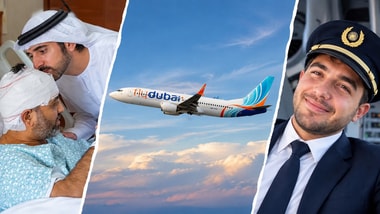
Flydubai Flight FZ1073 narrowly avoided disaster on 30 September after Omani co-pilot Hamam Al-Hammami allegedly attacked the aircraft’s Indian captain, Smit Machchhar, with an axe in an apparent attempt to take control of the plane.
Aviation commentator and veteran pilot Alastair Rosenschein said the incident raises questions about security screening, cockpit security and whether potential warning signs were missed.
Rosenschein, who spent around four decades in the UK aviation industry, told LiveMint in an exclusive interview that the incident should prompt closer scrutiny of how flight crew are screened and monitored.
Referring to media reports that the co-pilot had previously faced restrictions on flying in Oman over concerns linked to his alleged extremist views, Rosenschein said, “All the signs of this pilot’s radicalization were there for the security services to see.”
According to media reports, the flight plunged around 17,400 feet in less than two minutes before control of the aircraft was regained. The aircraft later made an emergency landing in , Saudi Arabia.
Rosenschein, who also served as a Royal Air Force () Education Officer and commanded the 39F Barnes Squadron from 2006 to 2018, praised Machchhar for his actions following the alleged attack.
“What he did was an act of immense bravery. Whilst he was being attacked with an axe, he managed to unlock the cockpit door. Now, unlocking the cockpit door from the cockpit is fairly straightforward in normal circumstances. But I think it’s entirely a different thing when you’re fighting for your life, and you’re injured.”
He said Machchhar’s actions, along with the intervention of passengers, were crucial in preventing the situation from becoming more serious.
“Without his action, there is no doubt this aircraft would have been lost. And without the quick thinking of the Israeli passenger who entered the flight deck, the would have been lost.”
Rosenschein said it was possible, based on the reported sequence of events, that the co-pilot placed the aircraft into a dive. He said the forces generated during such a descent could make movement inside the cockpit extremely difficult.
He also highlighted the reported intervention of a passenger who allegedly entered the cockpit and helped regain control of the aircraft.
“It was a very, very sharp thinking and quick reacting Israeli passenger who entered the flight deck, overpowered the co-pilot and reached forward and pulled the aircraft out of a dive, even though he had never flown an aircraft before.”
Rosenschein said the reported use of an emergency crash axe raises questions about how such equipment is secured inside the cockpit.
“The immediate thing to do is to secure the crash axe in a way that one pilot can’t get access to it without the other pilot knowing… So, that axe has to be secured in a much better way than it is at present.”
He said the broader issue was the security screening of flight crew. “But the main failing is in doing a proper security check on the flight crew.”
Referring to media reports that the co-pilot had previously faced flying restrictions in Oman over concerns linked to his alleged extremist views, Rosenschein said, “All the signs of this pilot’s radicalization were there for the security services to see, and not only for them, but also for his colleagues to see, for his friends to see, for his family to see. He was openly radicalized.”
He added, “Serious questions have to be asked of the security services in the , in Amman, and possibly also in .”
Rosenschein said regular psychological assessment and mechanisms for reporting concerns about crew behaviour could form part of a broader safety framework.
“I don’t think there is anything that can be done to prevent them other than proper psychological testing, frequent testing, and their colleagues should report them if they have any concerns over their behaviour or their attitude.”
He said screening should not be limited to pilots. “The psychological testing of cabin crew for exactly the same reasons is just as important because they are allowed entry into the cockpit of an aircraft.”
Rosenschein argued that security information involving people working in safety-critical sectors should be shared more effectively across jurisdictions.
“I think there should be international reporting for anybody who’s been radicalized. So that somebody like this, a very, very dangerous individual, should not have access to, and it’s not just . This applies to the nuclear industry… It applies to all forms of transportation.”