


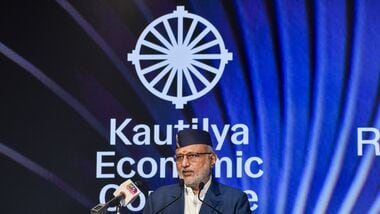
NEW DELHI: India can call itself a developed economy only when growth is inclusive and reaches every section of society, vice president C.P. Radhakrishnan said, highlighting the country’s position as the world’s fastest-growing major economy.
“We can call ourselves a developed economy, if it is an inclusive development for everyone,” Radhakrishnan said at the in New Delhi.
India’s real in the first quarter of fiscal year 2027 (FY27) stood at 7.8%, he said. But growth alone is not enough: its quality and inclusiveness will be central to India’s journey towards becoming a developed economy.
“Our economic progress also received international recognition. The Japan Credit Rating Agency upgraded India’s sovereign credit rating from BBB+ to A.” He said this reflected greater confidence in the strength of the Indian economy and public finances.
“Economic resilience cannot be separated from social resilience. The mark of our development is how benefits reach all the sections of the society,” the vice president said.
Pointing to China’s emergence as the world’s second-largest economy, Radhakrishnan said “policymakers should always understand the ground realities and the situation” and remain flexible so policies can succeed. India’s experience over the past decade, he said, shows that development matters only when it reaches every section of society.
“That is where inclusion itself can become an instrument of resilience. That is the success story of India today.”
The Jan Dhan-Aadhaar-Mobile, or JAM, trinity has created a foundation for financial inclusion by linking bank accounts, digital identity and mobile connectivity, Radhakrishnan said. Direct benefit transfers have built on it by moving government benefits directly into beneficiaries’ accounts.
More than 590 million Jan Dhan accounts had been opened as of August, he said, describing this as evidence of participation by the poorest among the poor. “The cumulative direct benefit transfer has been more than ₹53.4 trillion,” he said.
(GST), which Radhakrishnan called the biggest tax reform in India’s financial sector, has also helped integrate and formalise the economy. “By replacing the fragmented indirect tax structure with the common national framework and a digital compliance of architecture, GST has contributed to the integration and the formalization of the economy,” he said.
Registered GST taxpayers rose from more than 6 million in 2017 to over 16 million in May 2026, he said.
But inclusion is complete only when people gain the capacity to create value within the formal economy, not merely enter it, Radhakrishnan said.
Under the Deendayal Antyodaya Yojana-National Rural Livelihood Mission, more than 9 million self-help groups cover 100 million rural women, he said. The groups are becoming platforms not only for savings and credit, but also for skills, entrepreneurship, market access and collective economic action.
The Lakhpati Didi initiative takes that progression further, from inclusion to income and from income to entrepreneurship, he said. “As of 2026, more than 34 million self-help groups members have been enabled as Lakhpati Didi,” he said, adding that women are becoming major stakeholders in India’s growth story.
Education is central to that process, he said. A resilient economy is not built only in boardrooms, financial markets and large infrastructure, but also when a woman in a village has a bank account, a small enterprise enters the formal economy and a self-help group becomes an enterprise.
More than 250 million Indians have come out of extreme poverty to lead their lives with dignity under Prime Minister Narendra Modi’s leadership, he said.
Radhakrishnan also linked long-term economic resilience to India’s research ecosystem, highlighting the memorandum of understanding between the Delhi School of Economics and the London School of Economics. He said he hoped DSE would have a similar collaboration with Harvard in the future.
“We have to have better understanding with the economical thinkers of the globe, so that we also rise, we also contribute,” he said, adding that such partnerships can create opportunities for research, education and policy.
Ultimately, how GDP benefits every section of the economy should be taken into account, rather than GDP alone, he said.
“India’s development journey demonstrates that inclusion and growth can reinforce each other. Our task now is to deepen this foundation, harness technology responsibly, strengthen human capital and create greater opportunities for enterprises and innovation,” he said.