



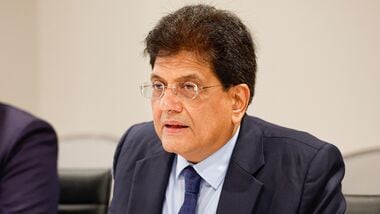
On Friday, the Union Commerce and Industry Minister clarified that India cannot endorse making the Most-Favoured-Nation () treatment conditional on obligations chosen by a select group of World Trade Organisation (WTO) members. He was attending the G20 Trade Ministers’ Meeting Session.
At the meeting, Goyal spoke on structural excess capacity and production, updating the Most-Favoured-Nation principle, ending forced labour in global supply chains, and the closing session.
Taking to X, Goyal said that he raised the issue regarding the MFN principle during the G20 Trade Ministers’ Meeting session.
“At the G20 Trade Ministers’ Meeting Session on the Most-Favoured-Nation Principle, I stressed that the MFN treatment guarantees that the smallest trader receives the same terms as the largest,” Goyal said.
He also emphasised India’s stance on making MFN conditional on obligations.
“Also reiterated that as we strengthen the multilateral trading system, preserving this balance can reinforce confidence, predictability & inclusiveness,” he added.
Earlier today, Goyal called for a World Trade Organisation-compliant approach to tackle trade distortions and excess capacity during the concluding day of the in Milwaukee, Wisconsin.
According to the Ministry of Commerce & Industry, the Minister stated that addressing unfair market practices needs strict adherence to established multilateral rules instead of unilateral actions.
“Trade-distorting support in some economies can lead to dumping and predatory pricing,” Goyal said in a statement. He said the concerns can be addressed through WTO-consistent instruments, including anti-dumping and countervailing duties, which rely on evidence and are subject to judicial review.
“Diversification of production and supply chains is a legitimate objective, but cannot be used as a pretext for measures outside rules or for shifting the burden of adjustment onto developing countries,” he added.
Goyal added that industrial capacity was not an issue. However, he believes that distortions could arise when geographical concentration of production is driven by opaque subsidies and other forms of support.
According to Goyal, India participated in the G20 meeting with a “constructive” approach. It discussed four themes, including structural excess capacity and production, the MFN principle, forced labour in global supply chains and the closing session.
Besides the meeting, Goyal also held bilateral discussions with trade ministers from countries including Australia, Saudi Arabia, France, South Korea and Canada, as per reports.
(with inputs from ANI)