



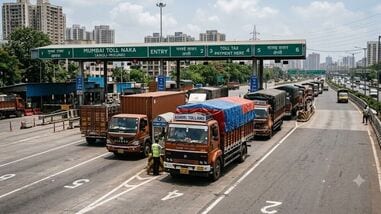
Commercial vehicles entering or leaving Mumbai will have to pay higher toll charges from October 1, following a revision announced by the Maharashtra State Road Development Corporation (MSRDC).
Under the revised rates, toll for mini buses and Light Commercial Vehicles (LCVs) has been increased to ₹90 from ₹75. Buses and trucks will now be charged ₹180, compared with the earlier ₹150, while the toll for heavy motor vehicles has gone up to ₹225 from ₹190.
The revised charges are applicable at five entry points to Mumbai — Airoli, Mulund LBS, Mulund Eastern Expressway, Dahisar and Vashi.
There will be no toll levy on private cars and SUVs entering Mumbai. Public transport buses, auto rickshaws and taxis will also continue to remain exempt from the entry toll.
The toll revision is therefore focused primarily on commercial vehicles using the city’s major entry routes.
According to MSRDC, commercial vehicle operators can also reduce their effective toll cost by purchasing toll coupons in advance. Operators buying 50 coupons will receive a 25% discount, while those purchasing 100 coupons will be eligible for a 50% discount.
Discount journey smart cards will be made available to eligible commercial vehicle operators at the toll plazas.
The increase has drawn opposition from transporters, who have argued that the higher toll burden will add to the cost of operating commercial vehicles. They said the additional expense could eventually be reflected in freight rates and passed on to consumers.
Bal Malkit Singh, adviser and former president of the All India Motor Transport Congress (AIMTC), said transport operators were already dealing with elevated operating expenses.
Singh urged the Maharashtra government to consider extending the toll exemption available to smaller vehicles to heavy commercial vehicles as well.
“Any increase in toll charges will directly increase the operating cost of transporters. To recover this additional burden, transporters will have to increase freight charges, which will ultimately be passed on to consumers,” said Singh.
Singh also questioned the need for imposing a higher toll burden on transport operators. He argued that contractors had already recovered the cost of constructing the roads and, therefore, there was no justification for placing another financial burden on the transport sector.
Transporters maintain that higher road-use charges could add to the overall cost of moving goods into and out of Mumbai, with freight operators potentially passing the additional expense on to businesses and consumers.
The revised toll structure has thus brought renewed focus on the cost of commercial transportation in Mumbai and the impact of road charges on the broader supply chain.