



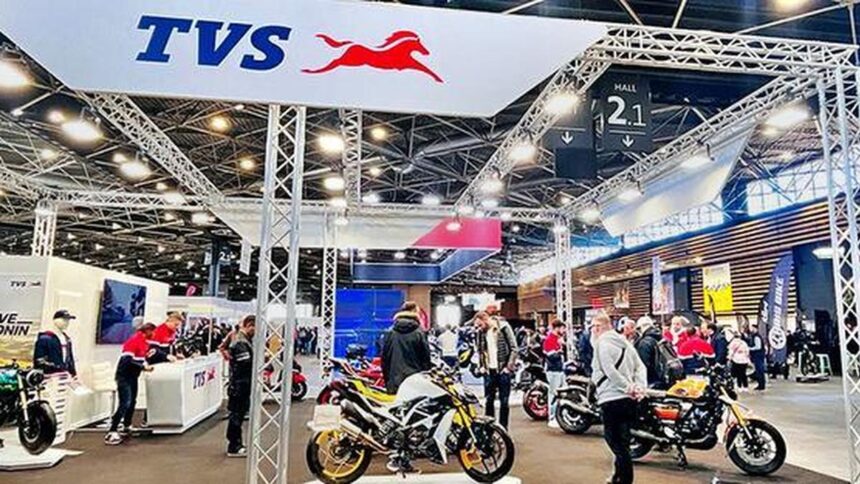
TVS Motor held off a fast-closing Bajaj Auto in September as electric two-wheeler registrations across 30 manufacturers jumped 12.5 per cent month-on-month to a nine-month high of 2.06 lakh, taking January-September registrations past 15 lakh — nearly 69 per cent higher than the corresponding period last year.
Registrations reached 15,51,355 during January-September 2026 against 9,18,934 a year earlier, an increase of 6,32,421 vehicles, or 68.8 per cent.
But underneath that expansion, a series of increasingly close contests is reshaping the leaderboard.
TVS remained the largest individual manufacturer with 4,11,441 registrations. Hero MotoCorp and Ather Energy, in which Hero is the largest shareholder with a 32.8 per cent stake and strategic partner — together registered 4,33,980 vehicles. For comparison, that was 22,539 vehicles, or 5.5 per cent, more than TVS, although the two operate separately and their registrations are not consolidated.
In September too, Ather’s 30,477 registrations and Hero’s 24,306 totalled 54,783, just 793 more than TVS’s 53,990.
Bajaj is mounting the closest direct challenge to TVS. Its September registrations jumped 17 per cent to 48,383 from 41,339 in August, while TVS grew 9.5 per cent from 49,286 to 53,990.
That cut TVS’s monthly advantage to 5,607 vehicles from 7,947. Over January-September, TVS’s 4.11 lakh registrations were 16.2 per cent ahead of Bajaj’s 3.54 lakh, but its September advantage was narrower at 11.6 per cent.
“The electric two-wheeler market is moving beyond early adopters, with distribution, financing, service reach and customer confidence becoming increasingly important as volumes scale,” said Vinkesh Gulati, former president of FADA and Chairman of ASDC.
Ather remains substantially ahead of Hero cumulatively, registering 2,61,451 vehicles during January-September against Hero’s 1,72,529, a lead of 51.5 per cent.
But their monthly race has tightened. Ather was 65 per cent ahead of Hero in March; by September that advantage had fallen to 25.4 per cent. Hero’s September registrations surged 27 per cent month-on-month to 24,306, while Ather grew 4.8 per cent to 30,477.
Ola is facing pressure from the other direction. Its registrations fell 3.5 per cent to 13,449 in September, the third consecutive monthly decline from 16,295 in June. Greaves Electric Mobility, meanwhile, grew 8 per cent to 9,316, leaving 4,133 vehicles between them.
Another close race is developing between River and BGauss. River registered 5,549 vehicles in September, compared with BGauss’s 5,023, a difference of just 526.
River also remained ahead during January-September with 38,713 registrations against BGauss’s 35,168, a gap of 10.1 per cent. Both, however, have nearly doubled their monthly scale since January. Their combined registrations increased from 5,394 in January to 10,572 in September.
“We have almost doubled our monthly registrations compared with the beginning of the year, but the opportunity is much larger,” said Hemant Kabra, Founder and Managing Director of BGauss.
Further down, September produced sharp breakouts. Bounce registrations nearly tripled month-on-month to 3,069 from 1,049, while Oben Electric more than doubled to 1,417 from 642, its strongest month in the nine-month period.
“As electric two-wheelers scale, there is a significant opportunity opening up for electric motorcycle players to push the envelope and widen the market beyond scooters. Motorcycles are a large part of India’s two-wheeler market, and their greater participation can help drive the next phase of EV adoption,” said Madhumita Agrawal, Founder and CEO of Oben Electric.
Published on October 2, 2026