



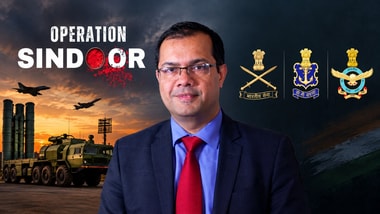
India’s ability to integrate diverse military systems during Operation Sindoor offered a key lesson for future warfare — weapons, sensors and platforms from different manufacturers must be able to communicate and operate together seamlessly, Dr Jaijit Bhattacharya, technology policy expert, told LiveMint.
“We won because we were perhaps the only military in the world capable of integrating diverse military systems together,” Bhattacharya told LiveMint on the sidelines of the Defence Tech Summit, which was organized by the Centre for Emerging Technologies at USI.
Bhattacharya, President, Centre for Digital Economy Policy Research (C-DEP), said India’s growing reliance on networked systems, data and artificial intelligence makes open architecture and interoperability increasingly important for the armed forces.
According to Bhattacharya, the challenge is to ensure that interoperability is built into from the design stage, rather than being created by the military during an operation.
Bhattacharya said modern cannot afford to rely on closed technology ecosystems that restrict the integration of systems from different manufacturers.
“We need to have open systems and open architecture. You just can’t give me a closed system like let’s say Apple as an example and say you can only integrate my systems and my missiles. That is not acceptable,” he said.
The issue is particularly relevant as Indian armed forces operate a wide range of platforms and weapons sourced from multiple domestic and foreign manufacturers.
Bhattacharya said India’s experience during showed that the military could overcome these technological barriers, but warned that such integration should not depend on workarounds.
“But we did it in spite of the providers of the military systems, not because they facilitated it,” he said.
Bhattacharya said that militaries cannot assume that technologies that prove effective in one conflict will retain the same advantage in the next.
“Lesson number one from every single operation is that the moment the operation is over, everything that you used to win the battle and the war more or less becomes obsolete immediately. Every battle is different,” he said.
‘If the is poisoned, that limits my brain from doing the war.’
As warfare becomes increasingly data-centric, Bhattacharya said protecting the integrity of military data is becoming as important as collecting it.
“One of the key pillars of warfare is data-centric warfare. If the data is poisoned, then that limits my brain to do the war,” he said.
He compared military communications and data networks with the nervous system of a biological organism.
“In the biological world, you will see that the most poisonous snakes are the ones with neurotoxins. If you compromise the communication system, the neural systems, then that’s the most deadly impact.”
Bhattacharya also flagged vulnerabilities within the powering modern equipment.
“In those billions of lines of code written, you’ll have a command saying ‘in case I want to get into it as a manufacturer, I should be able to get in through this back door’… so technologies become critical,” he said.
The proliferation of inexpensive drones has created another challenge for militaries: avoiding a situation where a low-cost unmanned platform requires a vastly more expensive weapon to destroy it.
Bhattacharya said India’s response demonstrated the importance of matching countermeasures to the type of threat.
“The beauty of what the did was create a response which is unprecedented, and use different kinds of weapons for different kinds of drones. We do not want to spend millions of dollars’ worth of missiles against small, cheap drones,” he said.
Bhattacharya said military intelligence is also evolving as technology expands the sources and dimensions of information available to armed forces.
“Information gathering is 360 degrees, and it’s going beyond 360° with Adint,” he said.
On AI, Bhattacharya said India cannot build an AI-enabled military simply by adapting technologies developed elsewhere.
“Unless you’ve got an complex, you can’t build the military on top of it,” he said. “In AI, we don’t have those systems in place. An AI-enabled military would require more than algorithms,” he added.
Bhattacharya also discussed the need for safeguards when is deployed in sensitive military applications.
“Either you distil the open-source models that are available, and then you put guard rails on it — basically, it’s called neuro-symbolic AI. The neuro part is what you distil, and the symbolic part you code around it so that there is no incorrect action that the AI does,” he said.