


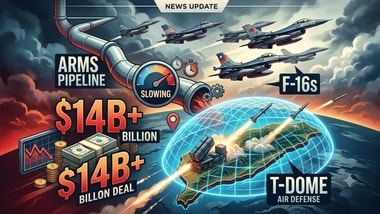
e is facing delays on two fronts: the first of its 66 new US-made F-16 Block 70 fighter jets remains in Hawaii, while a proposed $14 billion US weapons package that could strengthen Taipei’s planned T-Dome air-defence network remains on hold.
Taipei says it remains in discussions with Washington and has received assurances that US policy towards Taiwan has not changed.
Meanwhile, it was reported that US Preisdent Donald Trump offered to sell weapons to China while hosting its leader, Xi Jinping, last week.
US ambassador to China told Fox News on Sunday, “President Trump continues to say, hey, we sell arms to other people around the world. He actually asked President Xi, would he like to buy some at one point.”
On Monday, Chinese state media praised the “extraordinary level of courtesy” that Trump had shown Xi on the Chinese leader’s visit to Washington.
Taiwan ordered 66 F-16V aircraft from Lockheed Martin in 2019. The programme was originally expected to move much faster, but the timetable was disrupted by the relocation of Lockheed Martin’s F-16 production line from Fort Worth, Texas, to Greenville, South Carolina.
The programme also faced Covid pandemic-era supply-chain problems and production bottlenecks. Taiwan’s defence ministry has previously said supplier delays and changes to US assembly schedules contributed to the slippage.
Lockheed Martin later increased production to two shifts, with workers operating for as much as 20 hours a day in an effort to accelerate deliveries. In November 2025, Taiwan said production delays had pushed back the delivery schedule for all 66 aircraft.
The first two fighter jets, numbered 6727 and 6728, eventually left US and reached only till Hawaii. They were expected to continue across the Pacific towards Taiwan, but that journey has not yet been completed.
Taiwanese reports said the aircrafts were seen preparing to leave Joint Base Pearl Harbor-Hickam before apparently returning to the apron rather than continuing towards Guam.
The precise reason for the latest delay has not been publicly established.
Taiwan’s Defence Minister Wellington Koo did not give Reuters a delivery date on Tuesday. He said production had reached a stage where delivery was possible and referred to “compensation measures” linked to the delay. Lockheed Martin did not immediately respond to a Reuters request for comment.
The separate US$14 billion package has been held in abeyance since President Donald Trump’s May meeting with Chinese President Xi Jinping.
The proposed deal is expected to include hundreds of Patriot Advanced Capability-3 Missile Segment Enhancement, or PAC-3 MSE, interceptors, nine NASAMS air-defence systems and the Integrated Battle Command System, known as IBCS.
Together, these systems would help Taiwan connect different layers of air defence. Patriot missiles are designed to counter high-threat targets, including ballistic and cruise missiles, while NASAMS can defend against aircraft, drones and cruise missiles.
The package is also expected to include sensors that could improve the network’s ability to detect and track incoming threats.
Taiwan’s planned T-Dome system is intended to bring different air-defence capabilities into a more integrated network.
already operates or is developing several systems, including PAC-3 missiles, NASAMS, domestically produced Tien Kung III missiles and the Sky Sword II-based mobile air-defence system.
Taiwan has also sought to expand its missile stocks and develop additional domestic systems. In September, its cabinet proposed another $4.6 billion in defence spending, including funds for anti-ballistic missiles and large numbers of drones.
The F-16 delay and the stalled US $14 billion package are separate issues, but both highlight the time involved in expanding Taiwan’s military capabilities.
have warned that manufacturers face heavy demand and limited production capacity. Delays can mean missing planned production slots and waiting for later batches.
For now, Taipei says existing US arms agreements remain in place.
“As for arms sales, we are in continuous discussions with the Americans on this,” Taiwan’s Defense Minister Wellington Koo told reporters in Taipei. “We haven’t received any notice of any changes to sales or our cooperation.”
Koo also said Taiwan had received assurances from the US that its policy had not changed.