



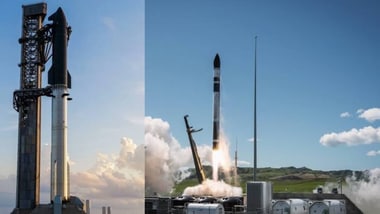
SpaceX is gearing up to launch the 14th flight of its giant Starship rocket later today, in a mission that could see the spacecraft reach Earth orbit for the first time.
The flight is also expected to feature the maiden deployment of SpaceX’s next-generation Starlink V3 satellites, which are designed to boost the capacity, speed and reliability of the company’s satellite internet service.
The launch window is scheduled to open at 7:15 am Central Time (5:45 pm IST) and will last for 75 minutes.
Viewers can follow the Starship Flight 14 launch through a live webcast on . is expected to start its livestream roughly 30 minutes before liftoff.
The mission is expected to take Starship to an altitude of around 275 km above , where it will make approximately six orbits during a flight lasting nearly 10 hours. The spacecraft is then scheduled to reenter the atmosphere before splashing down in the Pacific Ocean, west of Chile.
The Super Heavy booster will seek to complete several critical stages, including liftoff, ascent, separation from the upper stage, a boostback burn and a landing burn at an offshore site in the Gulf of America. SpaceX has made hardware and software upgrades following problems encountered during the previous flight.
Once separated, the Starship upper stage will attempt its first orbital insertion and release 26 V3 satellites. It will subsequently perform a deorbit manoeuvre using one Raptor engine before beginning its controlled return through the atmosphere.
Starlink V3 represents a new generation of SpaceX satellites, with improvements aimed at increasing capacity, data density and power generation. Each satellite is designed to handle up to 1 Tbps of downlink capacity and 160 Gbps of uplink capacity.
SpaceX says the specifications amount to a 10-fold increase in downlink capability and a 22-fold rise in uplink capacity compared with its Starlink V2 satellites.
Following deployment, the satellites will reportedly extend their antennas and solar panels and establish links with ground infrastructure and other Starlink spacecraft through radio-frequency and laser communications.
They will then gradually raise their orbits using onboard thrusters. SpaceX expects the satellites to potentially start providing service within a few weeks, once their initial checks in orbit are complete.
Three of the Starlink V3 satellites will be equipped with modified cameras to examine Starship’s heatshield during the flight. The collected images will be sent to SpaceX teams to help improve techniques for determining whether the heatshield is ready for future missions involving a return to the launch site.
At 407 feet, Starship is described by SpaceX as the largest and most powerful rocket ever built. The vehicle comprises the Super Heavy booster and Starship upper stage, both of which have been designed for rapid and full reusability.
SpaceX considers reusability central to its long-term ambitions for Starship, which the company believes could eventually support more extensive exploration of the Moon, Mars and other destinations in space.