


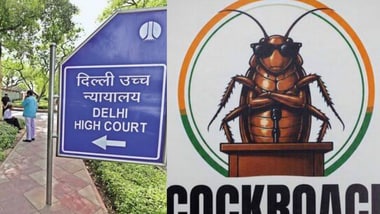
The Delhi High Court on Friday issued notices to Cockroach Janta Party (CJP) activists Abhijeet Dipke, Saurav Das, Ashutosh Ranka and Ratna Singh in a petition by a woman seeking the deletion of allegedly doctored and AI-generated images showing her with Prime Minister Narendra Modi.
The court also ordered that a copy of its directions be sent to Meta immediately and instructed the company to take down the identified objectionable material from its platforms within 24 hours, according to ANI. The investigating officer was asked to promptly share the relevant URLs with Meta to enable the removal of the content.
The court further directed that a copy of its order be sent to Meta without delay, along with notice of the petition.
The petitioner, through advocate Umesh Chandra Sharma, claimed that her photographs were used without permission and digitally altered with AI to create objectionable images showing her with PM Modi. She further alleged that the images were later shared across social media platforms and displayed at a demonstration associated with the .
“During recent protests held by the Cockroach Janta Party (CJP) at Jantar Mantar, New Delhi, respondents No. 2 to 5 (CJP leaders) along with their active accomplices-unauthorisedly harvested the personal photograph of the petitioner and utilised Artificial Intelligence (AI) face-swapping tools to morph her face onto a highly vulgar, compromising image alongside the Prime Minister of India,” the plea stated.
Justice Girish Kathpalia, hearing the matter, ordered the Delhi Police to provide the petitioner with full security and directed the police to submit a report within a week outlining the steps taken on the First Information Report (FIR).
The allegations made against the private respondents have not been decided by the court.
During the hearing, Sharma argued that the police had not taken adequate action even after an FIR was filed and said the petitioner was receiving threats.
Delhi Police counsel confirmed that an FIR had been registered based on the complaint.
The court noted that some of the requests seeking removal of the images would ordinarily fall within the jurisdiction of a civil court. However, given the sensitive nature of the matter and the urgency involved, it decided to examine the reliefs sought in the petition.
On the alleged objectionable content, the court took note of the petitioner’s submission that some of the web links attached to the petition were inaccessible. As a precautionary measure, it instructed the Registry to remove or conceal those links from the petition and accompanying documents.
The court also ordered the petitioner to submit all relevant photographs and videos to the investigating agency in electronic format, along with the corresponding web links.
The investigating agency was further directed to ensure that the photographs and videos remain strictly confidential.
On the question of the petitioner’s security, the court noted that her residential address had not been mentioned in the petition. It directed her to provide her complete address to Sub-Inspector Anurag, who would then pass the details to the concerned station house officer (SHO).
The SHO with jurisdiction over the petitioner’s residence was instructed to take all necessary and feasible measures to provide her with full police protection.
The court also ordered the authorities to submit a status report within two weeks outlining the security arrangements made for the petitioner. It also voiced concern about her safety and said it did not want any harm to come to her.