



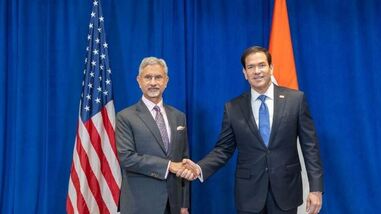
External Affairs Minister S Jaishankar on Wednesday raised India’s concerns over the United States’ new Russia sanctions law during a meeting with US Secretary of State Marco Rubio on the sidelines of the 81st United Nations General Assembly High-Level Week in New York.
The talks focused on the Lindsey O. Graham Sanctioning Russia and Iran Act of 2026 (SRIA), which was signed into law by US President Donald Trump last week. The legislation gives the US president authority to impose tariffs of up to 100% on countries that continue purchasing Russian oil and gas, including India and China.
said after the meeting that he had reiterated India’s “interests and concerns” regarding SRIA. The two ministers also discussed the situations in the Gulf and Ukraine.
The meeting comes as India assesses the potential implications of the new US law for its energy purchases and exports to the American market.
The legislation provides the US president with powers to impose additional tariffs on countries buying Russian crude oil and natural gas. However, the law itself does not automatically impose a 100% tariff on Indian goods. Instead, it creates statutory authority for the administration to impose such measures under specified conditions.
India remains among the major buyers of Russian crude, alongside China, making the issue particularly significant for New Delhi’s energy and trade interests.
Following the passage of the legislation, the Ministry of External Affairs said India would take necessary steps to safeguard its economic interests and energy security.
The Lindsey O. Graham Sanctioning Russia and Iran Act of 2026 expands the US sanctions framework targeting Russia and provides additional trade-related measures against countries continuing specified purchases of Russian energy.
For India, the legislation creates the possibility of higher US tariffs on Indian exports if the administration invokes the relevant provisions.
The potential measures come at a time when India and the US are also engaged in discussions on a bilateral trade agreement, adding another dimension to the economic relationship between the two countries.
Jaishankar and Rubio discuss wider regional issues
The meeting between Jaishankar and Rubio was not limited to the Russia sanctions legislation.
Jaishankar said the two sides also discussed developments in the Gulf and Ukraine. Rubio, meanwhile, said the US and India were working together on their strategic partnership, regional priorities and upcoming multilateral engagements.
“Together, we are building on the U.S.-India strategic partnership and coordinating on key regional priorities and upcoming multilateral efforts,” Rubio said in a post following the meeting.
“Good to meet @SecRubio of the US #UNHighLevelWeek,” Jaishankar posted. “Reiterated India’s interests and concerns with regard to SRIA. Also discussed the Gulf and Ukraine situations.”
New Delhi has maintained that its energy requirements remain an important consideration as it evaluates developments surrounding Russian oil purchases.
The Indian government has previously stated that it is committed to protecting energy security through diversified sourcing and decisions based on prevailing market conditions.
Reiterating India’s position on energy security, the ministry said, “As stated on several earlier occasions, India remains firmly committed to ensuring energy security for its 1.4 billion people. It will continue to do so through diversified sourcing and on the basis of evolving market dynamics.”
MEA added that the government was “monitoring further developments.”
The potential impact of the US legislation therefore extends beyond the energy sector, as any tariffs imposed under the law could also affect India’s exports to the US.
The discussions between Jaishankar and Rubio take place as India and the US continue negotiations on a bilateral trade agreement.
The two countries have been discussing issues including tariffs, market access, energy and broader economic cooperation. The latest talks also come against the backdrop of the newly enacted US Russia sanctions legislation, which could have implications for the wider trade relationship.
The two sides are continuing diplomatic engagement on both the trade negotiations and the broader strategic relationship as they address the evolving issues surrounding Russian energy, Ukraine and the Gulf region.