


Iranian President Masoud Pezeshkian used his address to the United Nations General Assembly on Wednesday (September 23) to accuse the United States and Israel of attacking Iran, reject accusations of terrorism and defend Tehran’s military and nuclear positions.
Pezeshkian’s speech came a day after US President Donald Trump warned at the same forum that he could “annihilate” the Islamic Republic if a deal was not reached. The address also followed renewed indirect US-Iran contacts through mediators on the sidelines of the UNGA.
Here are the key takeaways from Pezeshkian’s address:
Pezeshkian rejected Trump’s description of Iran as a terrorist state and said Iranians had instead been victims of terrorism.
“The United States president described us as terrorists. We have been the victims of terrorism,” Pezeshkian told world leaders.
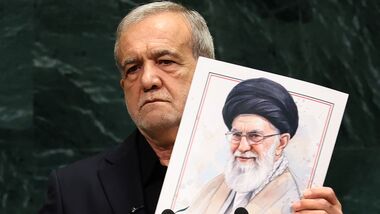
He held up photographs of the late Supreme Leader Ali Khamenei and children killed in the Minab school attack as he sought to present Iran’s account of the war.
“I come from an Iran in which our esteemed supreme leader was assassinated without any legal framework or reason,” he said.
“I come from an Iran where, in truth, they bombed a school,” he added, referring to the US attack on Iran’s Minab primary school on the first day of the war.
Pezeshkian said he came from “an Iran where, in truth, they bombed a school. You see, these children; these children perished under bombs with weapons used by the United States and Israel,” he said.
“They were innocent, had it no crimes,” he added.
Iranian officials have previously said the Minab school was struck on the opening day of the conflict, killing more than 100 children and teachers. The Minab attack and Khamenei’s killing were among the issues Iran said it would raise at the UN.
The Iranian president said Tehran had acted in self-defence after attacks by the United States and Israel.
“We have only defended ourselves. We are not terrorists.”
He accused the two countries of launching attacks against Iran and said Tehran had responded with force.
“Yes they did hit us, but we did not bend the knee.”
Pezeshkian defended Iran’s nuclear programme and reiterated Tehran’s stated position that it seeks nuclear energy rather than a nuclear weapon.
“Iran needs nuclear energy not nuclear bomb.”
The nuclear issue remains a central point of disagreement between Washington and Tehran as the two sides seek a possible diplomatic settlement.
Despite his strong criticism of Washington, Pezeshkian said Iran remained open to negotiations.
“Iran will not surrender with military power, believes in diplomacy.”
He called for dialogue without pressure or threats.
“We are ready for dialogue and diplomacy and negotiations without accepting the language of force.”
His remarks came as US and Iranian officials held indirect discussions in New York through mediators. Trump described the discussions as a “very good meeting”, while Iranian officials said Tehran’s negotiating position had not changed.
Pezeshkian said the Strait of Hormuz cannot be used to transport weapons that would subsequently be used against Iran.
“We cannot let some have free access and bolster their interests from the waterway, while at the same time using that waterway to impose their aggression upon us.”
The waterway has become one of the central disputes in negotiations. Washington wants free navigation through the strategic shipping route, while Tehran has linked its reopening to the lifting of the US blockade on Iranian ports.
The dispute has broader consequences because the strait is a critical route for global energy shipments.
Pezeshkian accused Western governments of applying what he described as a double standard to Iran and Israel.
“Israel kills, Tehran gets sanctioned, this is double standard.”
Pezeshkian said Iran needed to maintain sufficient military and national strength to withstand pressure from the United States and other adversaries.
“Iran needs to be strong and powerful to resist U.S., enemies.”
He described Iran’s military capability as defensive rather than offensive.
“Iran’s military power is defensive.”
Pezeshkian directly addressed Trump’s threats and warned that pressure could have the opposite effect from what Washington intends.
“Trump should know that threats unite Iranian nation.”
He said the Iranian people would continue resisting sanctions, pressure and what he described as bullying.
Pezeshkian rejected the characterization of Iran as an aggressor and said Tehran had historically been willing to negotiate.
“Iran has never ever been an aggressor, has never started a war and has always shown her commitment to the negotiating table.”
He said Iran had been forced into the conflict but had demonstrated that it was prepared to fight.
The speech combined strong accusations against Washington and Israel with an explicit call for diplomacy.
“They imposed the war on us, but we proved that we’re not afraid of fighting.”
He added that Iran was ready for negotiations but would not accept talks conducted under military pressure.
His remarks came as the first significant US-Iran diplomatic contacts in months took place on the sidelines of the UNGA. Iranian Foreign Ministry officials said Tehran’s conditions remained unchanged, including demands for an end to the US blockade and the release of frozen Iranian assets.