


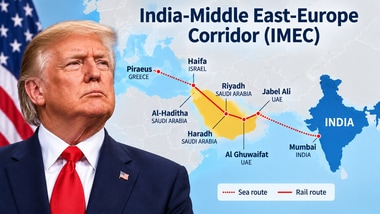
US President Donald Trump on Tuesday publicly backed the India-Middle East-Europe Economic Corridor (IMEC), saying the Iran war has highlighted the need to shift critical Middle East energy infrastructure away from vulnerable routes.
Addressing a meeting with Gulf Cooperation Council and Arab leaders on the sidelines of the in New York, Trump said attacks on commercial shipping had shown the need to move energy infrastructure away from what he described as Iranian checkpoints.
“That’s why my administration strongly supports the ,” Trump said.
Trump’s endorsement comes as the Iran war has disrupted regional shipping and energy flows following the Strait of Hormuz blockade, putting renewed focus on alternative routes.
The IMEC is a planned multimodal connectivity and infrastructure project designed to link India with the Gulf and Europe.
IMEC was officially unveiled at the in New Delhi in 2023 by India, the US, Saudi Arabia, the UAE, the European Union, France, Germany and Italy.
Under the framework, the eastern corridor would connect India with the Arabian Gulf, while a northern corridor would connect the Gulf with Europe.
The plan envisages maritime connectivity from India to the UAE, followed by rail and other transport links through Saudi Arabia and Jordan towards Israel and the Mediterranean. From there, goods would move by sea to European markets.
The original memorandum also envisaged electricity and digital cables along the railway route, as well as infrastructure for clean hydrogen exports.
The Strait of Hormuz is one of the world’s most important routes for global energy supplies, and disruptions in the region have raised concerns over the resilience of existing supply chains.
For India, IMEC is intended to create an alternative multimodal route to European markets.
It could reduce the time and cost of transporting goods between India, the Gulf and Europe.
The corridor could also strengthen India’s trade and infrastructure links with the Gulf and while providing opportunities in areas such as energy, digital connectivity and clean hydrogen.
The project also has a wider strategic dimension for India. It could link New Delhi more closely with key Gulf economies and European markets.
The project faced a major setback within weeks of its announcement.
The 7 October Hamas attack and the subsequent Gaza war dramatically changed the political environment in West Asia. normalization, which was an important part of the wider regional context surrounding the corridor, was disrupted, according to a research paper titled, Saudi Arabia’s new approach to Israel and the normalization process.
As the Iran war continues, the proposed route also passes through a geopolitically sensitive region involving the UAE, Saudi Arabia, Jordan and Israel, making regional stability important to its implementation.
An August 2026 assessment by Asia House said had stalled and faced significant challenges, although India continued to publicly support the project. It also highlighted the impact of the Iran conflict and the uncertainty surrounding ‘s participation.
IMEC remains largely at the planning and diplomatic framework stage.
“As of April 2025, the IMEC project is progressing according to the scheduled timelines, with major developments underway in the construction of transportation and logistics infrastructure. Further updates will be shared on this website as the project progresses,” the official IMEC website said.
The project has faced delays amid regional conflicts, first the Israel-Hamas war and later the US-Israel war with Iran.
Trump’s support is significant. IMEC was launched during the Joe Biden administration but is now receiving explicit backing from his successor.