



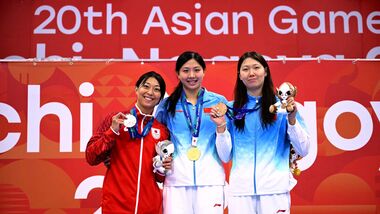
The first medals of the 20th are already around athletes’ necks in Aichi-Nagoya. India opened with two shooting silvers on Sunday. Suchika Tariyal is guaranteed another after reaching the mixed martial arts semi-finals. Japan’s Takumi Hojo took the first gold in the men’s triathlon. The hardware they collected is not a standard disc. It was built to look like something that broke and then came back together.
The official idea is the Games slogan, “Imagine One Asia.” The organisers say Asia once sat as one, then split into many languages and cultures. Sport is the reunion. “The medal expresses the idea of coming together again through sport, represented through both its surface finish and form,” the official Asian Games website reads.
That surface was not drawn first on a computer. Designer Daisuke Shiba smashed ceramic discs until a shape that felt natural appeared. “The designer envisioned that athletes, too, have endured countless hardships and challenges on their journey to this moment,” the website added. The cracks are the training years. The finished disc is the one moment they add up to.A
The front carries the Olympic Council of Asia sun mark. The reverse carries the Aichi-Nagoya emblem.
Shiba, representative director of MERRY BEETLE Co., Ltd. and of TOGU, won an open contest for design students and working professionals. A review committee chose the entry. He trained in architecture at Kobe University and later in interior design.
“I am deeply honored and delighted that my design has been selected as the medal design for the 20th (Aichi-Nagoya 2026),” Shiba said. “I sincerely hope that these medals, as symbols of the dedication and perseverance that athletes have accumulated through years of effort, will further enhance their sense of joy and pride.”
Notably, every medal is 80 mm across and 5 mm thick. The gold medal weighs about 265 g and is pure silver plated with at least 1 g of gold. The silver medal is about 264 g of pure silver. The bronze medal is about 222 g of red brass, 95 per cent copper, 5 per cent zinc.
The Aichi-Nagoya 2026 Recycled Medal Project collected small electronic devices from participating municipalities. Some of the metal recovered from those phones and gadgets went into the medals. The stated aim was the Sustainable Development Goals and a circular economy: old devices, new podium.
The ribbon carries the silhouette of the kakitsubata, the Japanese iris that is Aichi Prefecture’s official flower, plus arcs taken from its leaves. The official site says that the form “evokes the graceful strength of athletes while expressing a desire to connect Aichi’s culture with the world and pass it on to future generations.”
The case is octagonal inside and out. “The character “八” (eight) was historically used in the emblem of the Owari Tokugawa family, which once ruled the region that is now Aichi Prefecture, and is also incorporated into the current emblem of Nagoya City,” the website explained. The box is Aichi-grown Japanese cypress, or hinoki, the wood used in tea-ceremony boxes that hold precious objects.
That is what a 2026 medal actually is: recycled scrap, a cracked ceramic idea, a local flower, a Tokugawa eight, and a hinoki box. The podium is the last step. The object is meant to remember the ones before it.