



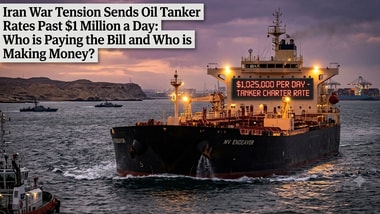
Oil tankers crossing the Strait of Hormuz are now earning even more than $1 million a day, as the Iran war has increased the risks and the urgency of moving crude through the key shipping chokepoint.
The cost of hiring a large crude carrier to transport oil from the Persian Gulf to China, which must pass through the Strait of Hormuz, reached $1.035 million per day this week, according to Baltic Exchange data cited by Fortune. In fact, for the first time, the rate has crossed the $1 million mark. Before the war, a similar transportation cost about $208,000 per day, based on the Platts VLCC index.
The price pressure comes as commercial traffic through the Strait of Hormuz has significantly decreased, with the US-Iran war now in its seventh month. Meanwhile, the need to move oil out of the Gulf has increased as restricted supplies have pushed crude prices above $100 a barrel again.
“It’s all about risk,” said Ioannis Papadimitriou, principal freight analyst at Vortexa, told Fortune.
This risk factor has become a major reason for the rise in the shipping bill. On Friday, two tankers were hit by projectiles in the Strait of Hormuz, underscoring that commercial vessels remain the primary targets of attacks.
Insurance costs have also surged. Premiums for vessels have risen to about 10% of the assets aboard, compared with around 0.5% to 1% before the war, Papadimitriou told Fortune. These higher costs are now being passed on to the charterers.
Fewer vessels willing to cross the more disrupted eastern side of the strait have further tightened shipping capacity. At the same time, some maritime companies are expanding their fleets to secure cargo deliveries and strengthen their position in the supply chain.
The higher freight bill is ultimately being felt by refiners. They face not only more expensive shipping but also higher crude costs, while alternative routes can take longer. The pressure on refinery margins can then feed through to consumers.
Fortune cited diesel prices crossing $6 for the first time, about 60% higher than before the war in Iran.
Shipping companies, meanwhile, are benefiting from the extraordinary rates. Clarksons, the world’s largest shipbroker, reported record earnings in the latest quarter, including a 55% year-on-year increase in operating profit.
The gains have also extended to shipping-focused investors. The Breakwave Tanker Shipping ETF was up more than 3,600% year to date, according to Morningstar data cited by Fortune.
“Every time there’s more geopolitical instability that creates trading inefficiencies, it’s the shipping players that actually benefit,” Papadimitriou said. “And this time is no different.”