


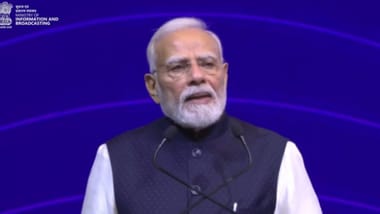
Prime Minister Narendra Modi inaugurated SEMICON India 2026 at the Yashobhoomi Convention Centre in New Delhi on September 17. The three-day semiconductor conference and exhibition, scheduled for September 17-19, will be attended by industry leaders, policy makers, investors, startups and academic institutions from around the world to discuss India’s ambition to become a semiconductor power.
The event is being organised by the India Mission (ISM), the Ministry of Electronics and Information Technology (MeitY) and the Silicon Electronics and Microelectronics International (SEMI), under the theme of “Silicon to Systems: Building the Ecosystem”. The objective of the conference is to foster investment and technology partnerships and build manufacturing capabilities and talent development in the semiconductor and electronics ecosystem in India.
PM Modi inaugurated the exhibition on Thursday at Yashobhoomi and had a word with the participants of the semiconductor industry. Over 600 exhibitors, including approximately 300 from overseas, this time with delegations from over 50 countries. The exhibition covers an area of approximately 15,000 square metres and features six country pavilions of Japan, South Korea, Malaysia, the Netherlands, Singapore and Sweden. There are also 12 pavilions of the state governments, and there is a startup pavilion.
MeitY said the event will highlight the advances in the semiconductor value chain from materials, manufacturing, advanced packaging, chip design, electronics and systems.
The “Sand to Silicon to Systems” Value Chain Experience is one of the highlights at the show. It will provide the user with an insight into the various stages of semiconductor manufacturing and also showcase India’s emerging strength in the semiconductor industry.
The Union government has approved 12 semiconductor projects under the Semicon India Programme. Three units that were approved under the first phase, Semicon 1.0, have now begun to enter into commercial production, said the MeitY.
The Union Cabinet has also given its nod to the next phase of the programme, Semicon 2.0. The new phase has been built around six key pillars which focus on growing the semiconductor ecosystem in India.
More than 150 speakers are participating in the conference, while companies from across the semiconductor and electronics supply chain are taking part in the exhibition.
The key participants are ASML, Applied Materials, Teradyne, Infineon, Ebara, Jabil, IBM Research, NXP, Tata Electronics, Micron, Merck KGaA, Rapidus, Lam Research, CG Power, Uno Minda and Tokyo Electron, among others.
Semiconductor industry trade group SEMI President and CEO Ajit Manocha says that India’s semiconductor ecosystem is set for “unprecedented exponential growth”, and must consolidate its footprint in various segments of the global semiconductor value chain. The company that started its first commercial production at its Sanand site earlier this year has said it will be creating and testing tens of millions of chips in India this year and hundreds of millions next year, and its engineering operations in India have resulted in over 3,700 patents, inventions and disclosures. Infineon Technologies is currently employing approximately 2,800 people in India and has increased its workforce by more than 28% in the past year, said Jochen Hanebeck, the company’s CEO. It has also opened a Centre of Excellence (CoE) with NIELIT, focused on semiconductors.
Tata Electronics will sign 16 MoUs at SEMICON India 2026 with international and domestic suppliers to strengthen India’s semiconductor supply chain, CEO Randhir Thakur said. He highlighted the company’s progress on its semiconductor fabrication facility in Dholera, Gujarat, and packaging unit in Jagiroad, Assam, with more than 450 ecosystem partners involved in the Dholera project. The agreements include companies from Europe, Japan, Malaysia and Singapore, along with Indian firms and institutions. Thakur said Tata Electronics has created more than 1.5 lakh direct jobs, with women making up 65% of its workforce, while 300 Indian university graduates are currently receiving technical training at PSMC facilities in Taiwan.