



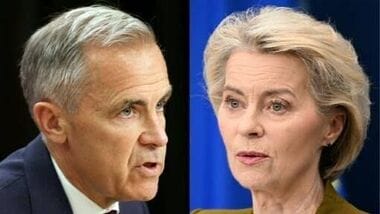
European Commission President Ursula von der Leyen on Wednesday proposed a new form of partnership between the European Union and Canada, inviting Ottawa to become the bloc’s first “associate member” as both sides look to strengthen economic and strategic cooperation.
“I invite Canada to be the first associate member of the EU,” von der Leyen said during her State of the Union speech.
Von der Leyen also called for expanding ties between the EU and Canada beyond their existing trade arrangements, with a focus on building a wider strategic partnership. “We will move from Comprehensive Economic and Trade Agreement (CETA) to an Alliance for the Future. To create a common prosperity and economic security space,” she said.
Leyen said the proposed partnership would extend across a wide range of areas, including advanced manufacturing, technology, defence, Arctic cooperation, energy, critical minerals, batteries, artificial intelligence, quantum computing, cybersecurity and economic security, according to AP.
“This is a partnership not against anyone else, but for our common strength. In short, we want to bring the relationship with Canada to the highest level possible,” she mentioned.
Leyen noted democracies should not be governed by the most powerful, wealthy or vocal, stressing that democratic nations have the freedom to decide who they want to cooperate with.
Canada cannot join the EU as a full member because the bloc’s treaties limit membership to European countries. The proposed associate membership could therefore provide an alternative arrangement, allowing Canada to establish closer ties with the 27-nation European bloc without becoming a full member.
The proposed partnership comes as Canada and the EU look to bolster economic resilience amid growing uncertainty in global trade. Relations between Ottawa and Washington have also come under pressure following US President Donald Trump’s trade policies and and threat of making Canada the 51st state.
Canada remains particularly sensitive to shifts in US trade policy given the deep economic links between the two North American neighbours. The relationship has faced fresh tensions as the Trump administration has imposed tariffs and signalled the possibility of additional measures targeting Canadian exports.
In response, Canada has been seeking to broaden its network of trade and economic partners, while European countries have been working to reinforce supply chains and address strategic vulnerabilities.
Canadian Prime Minister Mark Carney has backed stronger economic and security cooperation with the European Union. His appearance in the European Parliament on Wednesday reflected the growing engagement between Ottawa and Brussels.
Carney was also given a standing ovation after European Parliament President Roberta Metsola introduced him as the guest of honour.
He is set to speak before the European Parliament on Thursday morning.
Meanwhile, Canadian and European leaders are also expected to gather in Montreal later in October for a summit, with discussions likely to focus on trade, defence, energy, critical minerals, technology and cooperation in the Arctic.