



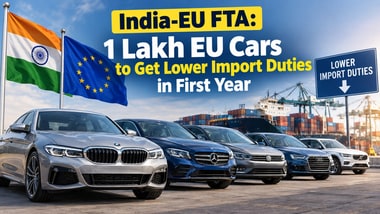
The proposed India-EU Free Trade Agreement (FTA) will allow European automakers to import up to 1 lakh completely built-up (CBU) internal-combustion engine (ICE) and non-plug-in hybrid passenger vehicles into India at concessional duties in the first year, according to the draft tariff schedule reviewed by PTI.
The quota is going to be increased in steps and will be 1.6 lakh vehicles in the 10th year. The trade deal was finalised in January 2026 but hasn’t been signed yet and has to pass the respective internal approval stages before it comes into effect. It is expected to be signed by the end of 2026 and could come into force in 2027.
The rates of the vehicles will be based on their CIF value and will be concessional. Any car costing less than €15,000 won’t be eligible for the lower tariff. This will see vehicles priced from €15,000 to €35,000 qualify for the lower rate of in-quota duty, which at present is 110% of their price. The rate will slowly decline to 10% after the 5th year.
A 30% duty on cars costing more than €35,000 will be applied for the first year, whereas the current MFN rate is 66%. The preferential rate also will be 10% in the fifth year.
The 1 lakh-unit quota will be divided into three price bands. About 34,000 units will be allocated to priced between €15,000 and €35,000, while 33,000 units each will cover the €35,000-€50,000 and above-€50,000 categories.
This will increase to approximately 1.075 lakh vehicles in the second year and 1.3 lakh in the fifth year. It will then grow steadily from the 10th year onwards to 1.6 lakh units. The draft rules stipulate that from the fifth year 43,000 units will be set aside for vehicles costing more than €50,000.
Cars imported outside the quota will continue to face higher duties, although these rates will also decline gradually. The out-of-quota duties are expected to be reduced to 30-35% of the vehicle’s price by the 10th year.
From the fifth year onwards, separate concessions for BEV (Battery Electric Vehicle), (Plug-in Hybrid Electric Vehicle) and the other eligible technologies.
The benefit will be available for vehicles with a price tag of €20,000 or more. The CBU quota will start at 20,000 vehicles in Year 5, rise to 50,000 by Year 10 and reach 90,000 from Year 14 onwards. The in-quota duty will be reduced from 30% in Year 5 to 10% in Year 10, in addition to the existing base duty of 110%.
With lower tariffs, it would be easier for European manufacturers to import CBUs, especially niche, high-priced models, to India.
The first-year quota under the FTA would be 1 lakh vehicles, and India imported 17,191 cars from the EU in 2025, said Ajay Srivastava, founder of GTRI, according to ET Auto. The concession provision could spur other key trading partners such as Japan and South Korea to follow suit in granting automotive concessions, he said.