



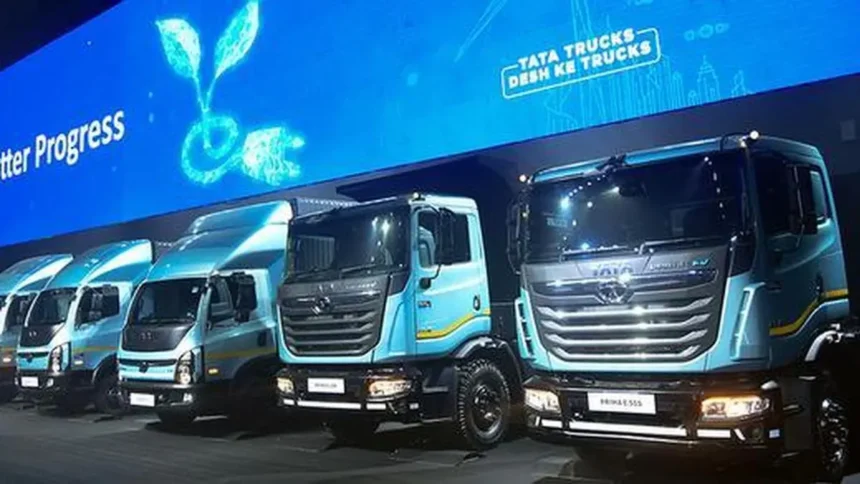
Commercial Vehicle (CV) retails at 99,666 units grew 24 per cent in July 2026 compared with the same period a year ago. Rural market led the pack decisively again, growing 29 per cent YoY against a 19 per cent upswing in the urban market, confirming that the demand for movement of goods continues to broaden beyond the metros, according to the Federation of Automobile Dealers Association (FADA).
The EV share among CVs marked an all-time high of 4 per cent against 2 per cent a year ago. Nonetheless, dealers remain watchful of the July price increases and input-cost pressures on fleet operators’ ownership economics, said FADA. Dealers also cited cement, steel, and mining-linked movement, e-commerce logistics, and improving finance availability, even as school-bus season demand tapered.
Tata Motors retained its position as the market leader and strengthened its lead over the rest of the industry during the month. The company’s growth was also among the strongest in the top five, helping it gain market share. Mahindra & Mahindra remained the second-largest CV manufacturer. While its volumes increased year-on-year, its market share saw a marginal decline, FADA data showed.
Ashok Leyland retained the third position; VE Commercial Vehicles, a JV between Volvo Group and Eicher Motors, retained the fourth position while Maruti Suzuki India completed the top five.
Shenu Agarwal, Managing Director and CEO, Ashok Leyland, in a recent analyst call, had admitted that fleet utilisations were holding up and freight rates and operator profitability were moving northwards. “So far, we have remained largely immune from tariffs and other geopolitical uncertainties. We believe the uncertainties pertaining to commodities, especially steel, would also settle down in the coming quarters,” he had said.
The July numbers also indicate that India’s CV demand is entering a broader and more sustainable growth phase, said Bal Malkit Singh, CMD of the Mumbai-based Bal Roadlines. “As an industry, we are seeing demand being driven not only by rural economic activity, but also by rapid infrastructure development, replacement of ageing vehicles, vehicle scrappage, and stricter norms on older commercial vehicles. The NCR restrictions on older vehicles, the 8-year vehicle-age clauses in several tenders, and similar restrictions in some metros are also accelerating fleet replacement,” said Singh, who is also the Advisor and Former President of All India Motor Transport Congress..
Poonam Upadhyay, Director, Crisil Ratings, said e-commerce logistics and the expansion of last-mile delivery networks supported demand for light CVs, while infrastructure activity and freight movement from core sectors such as steel, cement, and mining drove growth in the medium and heavy segments.
Published on August 18, 2026