


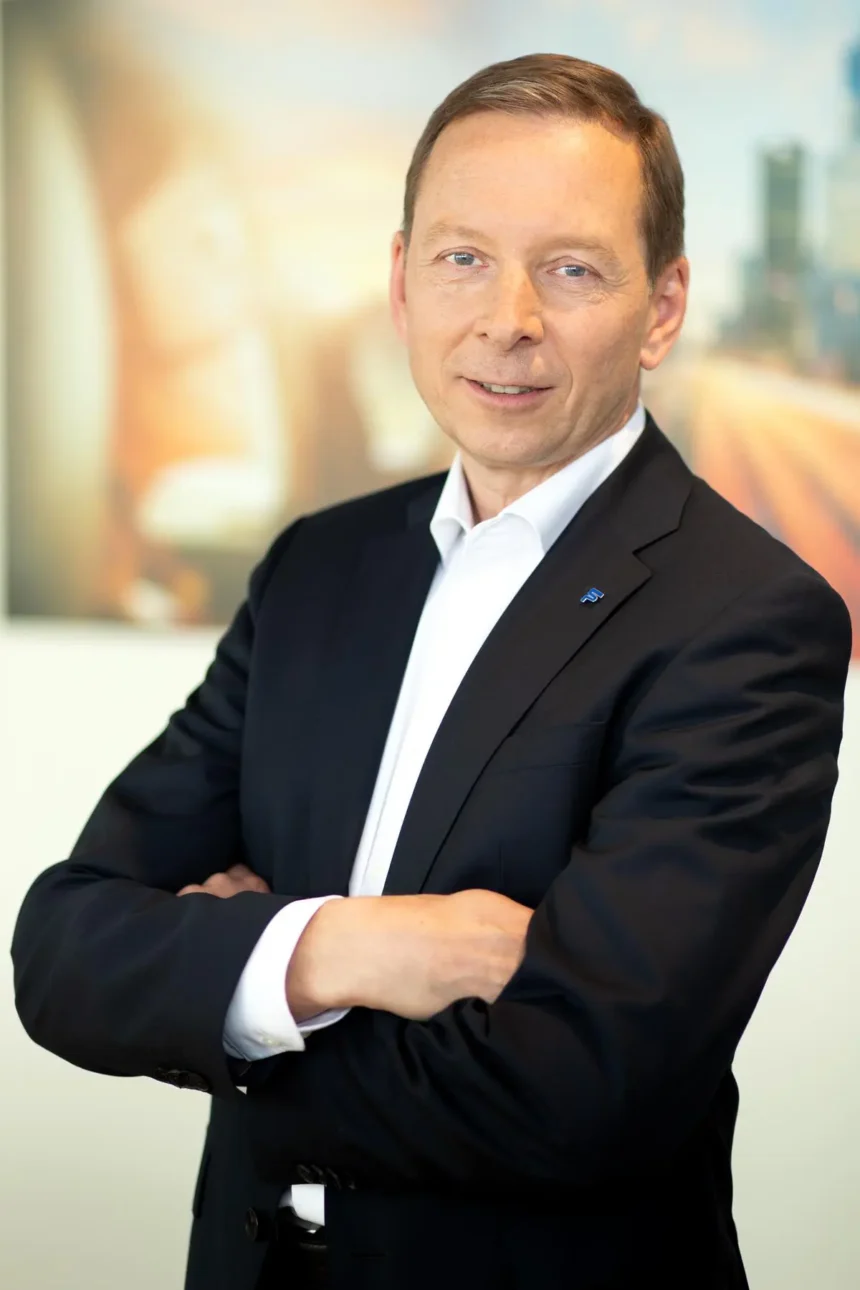
FORVIA Chief Executive Officer Martin Fischer speaks to businessline about the shift from centralised decision-making to local product ownership, why “local for local” is redefining automotive supply chains, how software is transforming component suppliers and what it takes to build empowered engineering teams in India.
India has long been known as an engineering and software hub for global automotive companies. What is changing?
India is moving into a very different phase. Earlier, much of the work here supported global programmes. Today, India is increasingly becoming a market where products are conceived, engineered, validated and launched closer to customers.
That’s important because customers expect faster response times and products that reflect local market requirements rather than adaptations of solutions developed elsewhere.
Even as India’s role grows, I believe it remains under-represented within the global automotive industry. The opportunity is much bigger than where we are today. The next stage is not simply expanding engineering capability, but giving local teams greater responsibility for products, customers and business decisions.
You often describe your approach as “local for local.” Why has that become such an important strategy?
The automotive industry has changed significantly over the past decade. Supply chains have become more regional. Customers increasingly expect suppliers to manufacture close to where vehicles are produced. That improves responsiveness, reduces logistics risks and makes the business more resilient.
You can see this across Europe, North America and China. Every region is becoming more self-sufficient. India is following the same path. If you want to serve customers well, you need engineering, manufacturing and decision-making close to those customers. That is what “local for local” really means.
Software-defined vehicles are changing the industry. How does that change the role of an automotive supplier?
The biggest transformation is that software and electronics are becoming central to the vehicle.
Earlier, suppliers focused on individual mechanical systems. Today, we are talking about integrated electronics architectures, zonal controllers, radar technologies, battery-management systems and increasingly artificial intelligence.
The value is no longer only in manufacturing components. It is also in integrating hardware and software into complete vehicle systems.
That requires different skills, closer collaboration with vehicle manufacturers and much shorter development cycles than the industry was used to a decade ago.
India is often associated with cost engineering. Can it also become a technology and product-development leader?
Absolutely. India has demonstrated for many years that it can deliver outstanding engineering talent. The next step is ensuring those engineers have ownership.
Innovation is not simply about spending more money. It is about empowering teams to solve problems, develop products for local market conditions and make decisions closer to customers.
The industry sometimes describes this as frugal engineering, but I see it as smart engineering, developing products that deliver value without unnecessary complexity. That capability will become increasingly important as customers seek technology that is both advanced and affordable.
Automakers are simultaneously investing in internal-combustion engines, hybrids, battery-electric vehicles and even hydrogen. How should suppliers prepare for such an uncertain future?
We don’t believe suppliers should bet on only one technology. Different markets will move at different speeds. Some regions will adopt battery-electric vehicles faster, while others will continue using hybrids or highly efficient combustion engines for many years.
Our role is to support customers regardless of the technology they choose. That means remaining technology agnostic while continuing to invest across multiple powertrains and vehicle architectures. Ultimately, customers—not suppliers—will determine how quickly each technology develops.
Beyond technology, what kind of organisation are you trying to build?
One built on trust and empowerment. I don’t believe large global organisations can continue making every important decision from headquarters. Leadership today is about creating strong local teams that understand their markets and have the authority to act.
That requires decentralisation, but it also creates accountability.When engineers, programme managers and business leaders feel genuine ownership, they make better decisions because they are much closer to customers and market realities.
For me, that is one of the biggest leadership lessons—not only for the automotive industry but for any global company operating across diverse markets.
Published on July 26, 2026