



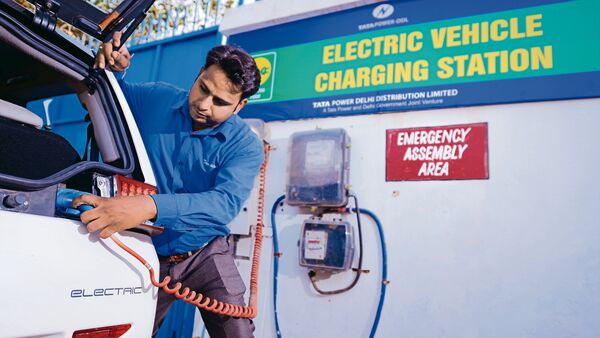
New Delhi: Automobile dealers are navigating the unforeseen impact of growing clean mobility, as low-maintenance eat into their income from regular vehicle maintenance.
The share of petrol passenger vehicle sales slipped below that of , including EVs, hybrids and CNG, for the first time in August, data from the Federation of Automobile Dealers Association (Fada) showed. Dealers have begun discussions with manufacturers to help them offset the loss of service income, an industry executive said, as EVs do not require routine maintenance work such as filter and lubricant changes and cleaning ignition and exhaust systems.
“EVs give you a lower revenue stream in service when you compare it with ICE (internal combustion engine) vehicles, said Sai Giridhar, president of the Federation of Automobile Dealers Association (Fada). “As EV penetration increases, somewhere down the line, there will be some kind of corrective steps being taken by OEMs (original equipment manufacturers) to adequately compensate dealers servicing these vehicles,” he added. Manufacturers could support dealerships with higher sales incentives for EVs, Giridhar suggested.
A request for comment from the automobile industry body Society of Indian Automobile Manufacturers (Siam) went unanswered.
While precise financial breakdowns are not readily available, given the fragmented and unorganized nature of auto dealerships, a 2024 report by rating agency Icra noted that servicing and spare parts remain critical to dealer margins. “Owing to stiff competition and the resultant impact on profitability of the vehicle retailing business, automobile dealers are increasingly focussing on lucrative spare parts and services business to support profitability,” the report highlighted.
Cumulative alternative-fuel passenger vehicle sales (including EVs, hybrids and CNG-powered vehicles) reached 168,805 units during August, posting a 38% year-on-year growth. In contrast, petrol car sales stood at 164,379 units, growing just 2% year-on-year, Fada data showed. According to the industry body, alternative-fuel models captured a record 41.95% market share, overtaking petrol-powered cars’ 40.85% share. EV retail sales jumped 53% to 298,448 units in August, marking the segment’s strongest August performance to date.
“EV two-wheelers crossed 10% (penetration) in a non-festive month; electric CV (commercial vehicles) was at an all-time monthly high,” Fada said in a statement.
A June 2025 study by the Council on Energy, Environment and Water highlighted that EVs carry significantly lower annual maintenance costs than ICE vehicles. For example, maintaining an electric SUV costs at least 32% less per year than a diesel SUV, the study found. For electric two-wheelers, servicing costs per kilometre are 29% lower than for their petrol counterparts, it said.
Amit Kaushik, founder at MobiDx.AI, a New Delhi based-automotive focused intelligence and analytics firm, said that dealers have to keep in mind that automakers have had to invest more in making EVs cost-competitive and they cannot afford to make them costlier.
“For dealers of legacy automakers, these EVs are another addition to the large portfolio where they don’t have to make large investments. With pure play new EV companies, they are offering much better margins to these dealers; so, they will have to cooperate. There is a partial impact on servicing revenue as some part of periodic maintenance and general repair and full body shop work is still there,” he said, suggesting dealers explore additional revenue streams like insurance, financing and other allied verticals.