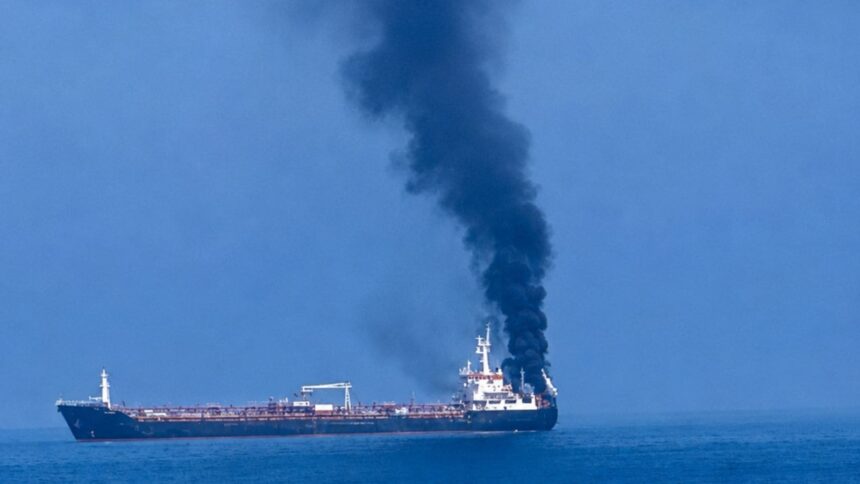
Iran on Saturday dismissed US President Donald Trump’s allegation that Tehran was behind a drone attack on Indian-linked commercial vessels near the Strait of Hormuz, calling the accusation “simply baseless” and accusing Washington of trying to divert attention from attacks that killed three Indian sailors.
“The US president’s accusation against Iran regarding an Indian vessel in the Strait of Hormuz is simply baseless. It is an attempt to divert public attention from the brutal fact that the US has attacked 3 Indian vessels in less than a week and killed 3 innocent Indian sailors. That’s pathetic!” the Iranian Embassy in India said in a post on X,
The U.S. president’s accusation against Iran regarding an Indian vessel in the Strait of Hormuz is simply baseless. It is an attempt to divert public attention from the brutal fact that the U.S. has attacked 3 Indian vessels in less than a week and killed 3 innocent Indian…
— Iran in India (@Iran_in_India)
The sharp response came hours after US President accused Iran of targeting Indian vessels transiting the Strait of Hormuz.
“Their totally rebuffed Drone attack last night against Indian Ships leaving the Hormuz Strait is TOTALLY UNACCEPTABLE. They better get their act together, and FAST!” Trump wrote on his official social media platform Truth Social.
The US president also accused Iran of leaking the terms of the West Asia peace deal to the media.
Iran’s response echoed remarks made earlier by Foreign Ministry spokesperson Esmaeil Baqaei, who accused the United States of carrying out attacks on commercial vessels carrying Indian crew.
“The brutal US attacks on Indian commercial vessels which have killed at least three Indian nationals, stand as clear evidence of America’s ongoing policy of armed robbery and State piracy,” Baqaei said on X, while offering condolences to the families of the deceased sailors and the Indian government.
The brutal U.S. attacks on Indian commercial vessels which have killed at least three Indian nationals, stand as clear evidence of America’s ongoing policy of armed robbery and State piracy.
We extend our sympathies to the families and friends of the slain Indian sailors and…
— Esmaeil Baqaei (@IRIMFA_SPOX)
The exchange came after a , according to Reuters, while was attacked a day later. India has twice summoned the US chargé d’affaires in New to protest the attacks and described the use of force against civilian shipping as unacceptable.
The exchange highlights how India, despite not being a party to the conflict, has increasingly found itself drawn into the fallout, with Indian seafarers caught in attacks and New Delhi forced into rare diplomatic confrontations with Washington.
In its statement after the death of three Indian sailors, the Ministry of External Affairs had said it had conveyed to the US its deep concern over the use of lethal and deadly force against civilian shipping. “Such actions are unacceptable and undermine the safety, security and stability of international maritime commerce in a sensitive region at a difficult time,” the MEA said.
The dispute has unfolded even as Washington and Tehran signal progress towards a possible agreement to end the ongoing conflict. However, tensions around the Strait of Hormuz remain high.
On Friday, US Central Command said its forces had intercepted multiple Iranian drones allegedly targeting commercial shipping in the strait. Iran has denied responsibility for such attacks. The claims could not be independently verified.
Iran launched multiple one-way attack drones in an attempt to strike commercial ships transiting the Strait of Hormuz. U.S. forces have downed all of them in recent hours as traffic flow through the strait continues unimpeded. The international trade corridor remains open for…
— U.S. Central Command (@CENTCOM)
For India, which relies heavily on the Gulf for energy imports and supplies thousands of seafarers to the global shipping industry, the escalating blame game has transformed a distant geopolitical conflict into a direct concern for its citizens and economic interests. after the Philippines, with thousands working aboard commercial vessels transiting the Gulf.