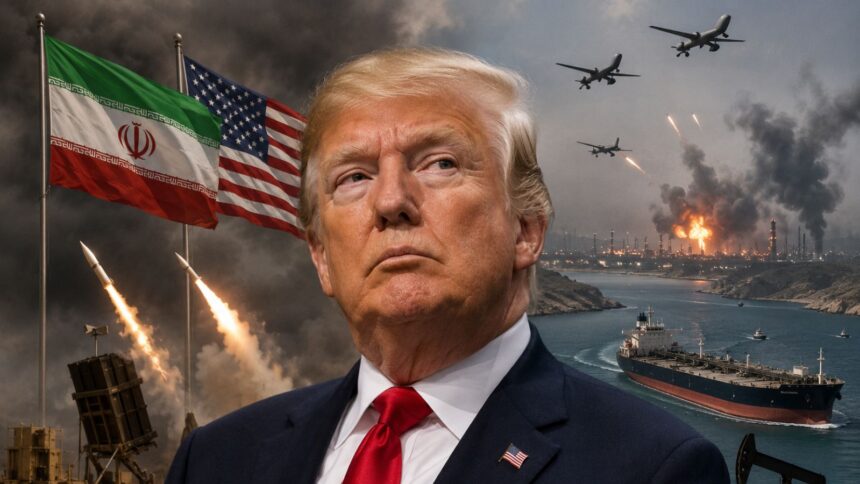
US President Donald Trump on Friday accused Iran of misrepresenting the terms of an emerging that “bear no relation to the truth”, while condemning what he described as a failed drone attack on Indian-linked commercial vessels near the Strait of Hormuz.
The comments came as India grapples with the fallout of the conflict, having lost three seafarers in one strike and narrowly avoiding further casualties in another attack involving Indian crew.
“The terms that Iran leaked out to the Fake News have NOTHING to do with the terms that were agreed to, in writing,” Trump wrote on Truth Social.
“What they said, including their weak and pathetic statement on having a deal, bears no relation to the truth. Very dishonorable people to deal with. With them, there is no such thing as dealing in good faith. AMAZING!” he added.
Trump also struck a notably different tone on attacks involving Indian shipping in the Gulf.
“Their totally rebuffed Drone attack last night against Indian Ships leaving the Hormuz Strait is TOTALLY UNACCEPTABLE. They better get their act together, and FAST!” he said.
Trump’s remarks place Indian lives and commercial interests at the centre of an escalating US-Iran dispute. India, the world’s second-largest supplier of seafarers after the Philippines, has already lost three sailors in a US strike on a commercial tanker off Oman, while another vessel carrying 20 Indian crew members came under attack a day later.
With nearly a fifth of global oil supplies transiting through the Strait of Hormuz and millions of Indians living and working across the Gulf, continued instability threatens both India’s energy security and the safety of its nationals.
Trump’s latest comments marked a sharp reversal from his optimistic tone a day earlier, when he said he had called off planned strikes on Iran because a deal had effectively been reached.
However, Iranian officials have publicly outlined terms that appear to differ significantly from Washington’s stated objectives.
A senior Iranian source told Reuters that the draft agreement would include the lifting of sanctions on Iranian oil exports, the unfreezing of billions of dollars in Iranian assets and a cessation of hostilities across multiple fronts, including Lebanon.
The source said issues surrounding Iran’s nuclear programme would be deferred to future negotiations.
Washington has consistently maintained that any agreement must ensure Iran never develops a nuclear weapon, while Tehran insists its nuclear programme is peaceful.
Trump’s reference to Indian vessels comes amid growing anger in India over the toll the conflict has taken on its seafarers.
A Palau-flagged oil tanker, Marivex, carrying 24 Indian seafarers, was All crew members were safely rescued. On June 10, the US struck another Palau-flagged tanker, on board. Another vessel, Jalveer, a Guinea-Bissau-flagged tanker with 20 Indians, was attacked on Thursday.
Why US bomb killed Indians?
The US-Iran war is leading to Indian casualties.
US has attacked three ships in recent days — all of them carried Indian crew who had to be rescued. But three of them weren’t so lucky, including 23-year old Aditya Sharma. He wasn’t supposed to be on…
— The Indian Express (@IndianExpress)
The deaths prompted New to summon US chargé d’affaires Jason Meeks for the second time in three days to protest the use of force against civilian shipping.
India’s Ministry of External Affairs said it had conveyed its “deep concern over the use of lethal and deadly force against civilian shipping”, describing such actions as unacceptable and detrimental to maritime stability.
The incidents have also triggered calls for Prime Minister Narendra Modi to raise the issue directly with Trump when the two leaders are likely to meet on the sidelines of next week’s G7 summit.
In a social media post, the US Central Command said on Thursday that Jalveer was “disabled” as a combat aircraft fired “repeatedly failed to comply with directions from US forces”. It said that Jalveer “violated the blockade against Iran by attempting to transport Iranian oil”.
The MEA emphasised that these attacks “must stop”.
Despite Trump’s insistence that Iran should “get their act together”, major sticking points remain unresolved.
Iran continues to seek sanctions relief, access to frozen assets and broader regional concessions, while the US is pushing for stronger assurances on Tehran’s nuclear ambitions.
The apparent disagreement over the terms of a proposed deal underscores the fragility of the diplomatic process, even as both sides signal a desire to avoid a wider war.
For India, the stakes extend beyond geopolitics. Any prolonged disruption in the Strait of Hormuz risks driving up oil prices, disrupting trade routes and exposing thousands of Indian seafarers operating in one of the world’s busiest maritime corridors to further danger.
(With inputs from Reuters)