



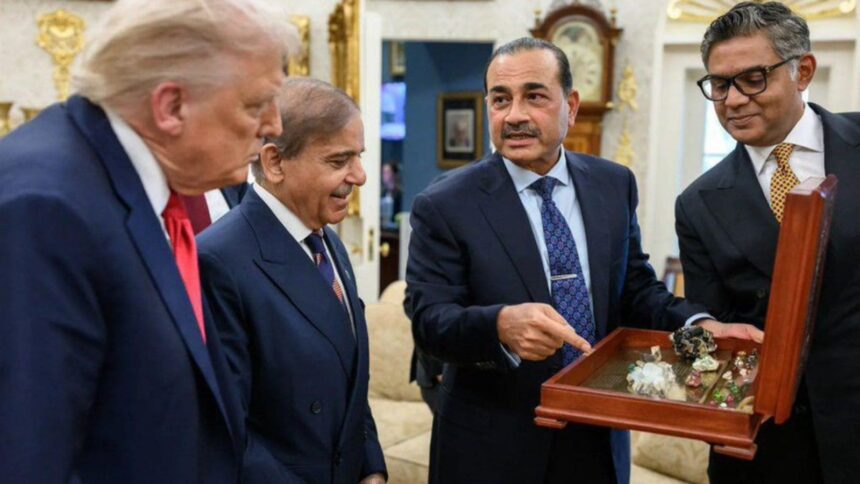
US President Donald Trump on Thursday credited Pakistan and several Gulf states with helping avert planned American strikes on Iran, saying he had “given Iran a break at the request of Pakistan” as talks with Tehran advanced. Trump had declared the US would strike Iran “very hard” again on Thursday, but later said he was cancelling the strikes because negotiators had “just made a great settlement” with Iran.
Trump’s remarks about Pakistan are seen as an unexpected diplomatic victory at a time when Islamabad has been seeking to project itself as a regional stabiliser. The acknowledgement also underscores the growing role of middle powers in backchannel diplomacy, while any easing of US-Iran tensions could help stabilise global oil markets. For India, which depends heavily on Gulf crude imports, de-escalation would reduce the risk of supply disruptions and further spikes in fuel prices.
Trump praises Pakistan’s Asim Munir:
I call him the General. He is a general. He is a great general—so great that he is actually a field marshal, a step above.
— Clash Report (@clashreport)
“We just made a great settlement of the war with Iran,” Trump declared while he opened an Oval Office event, hours after threatening on social media that the US would hit Iran “VERY HARD TONIGHT” and take “total control” of its oil and gas industries.
Trump added that discussions and the final points of a proposed agreement had been approved “in both concept and great detail” by all parties, including the US, the UAE, Qatar, Israel, Saudi Arabia, Türkiye, Bahrain, Kuwait, Pakistan, Jordan and Egypt.
Trump especially credited , Pakistan’s Prime Minister and Asim Munir, Chief of Defence Staff Field Marshal. He added that Islamabad was continuing efforts to persuade Tehran to reach an agreement. Saudi Arabia also persistently persuaded parties to return to “constructive negotiations sponsored by the brotherly Islamic Republic of Pakistan,” alongside Qatar.
The development comes amid renewed efforts by Pakistan to position itself as a diplomatic player beyond South Asia.
Iran’s Foreign Ministry spokesperson Esmail Baghaei said on state television that the deal is “mostly finalised”. He also added that contradictions on America’s behalf had caused turmoil in the process. The Foreign Ministry of Iran also mentioned that US attacks had “effectively rendered the ceasefire meaningless”, without officially abandoning it.
Trump had earlier threatened to seize Kharg Island, through which 90 per cent of Iran’s oil exports pass. But later he expressed doubt. He told Fox News, “I don’t know that America has the stomach for it.”
Meanwhile, the US naval blockade remains in force. The US military confirmed that it had struck a merchant vessel in order to escape the blockade. The three Indian sailors who were killed in an earlier strike on a separate tanker drew condemnation from the International Maritime Organisation.
Why US bomb killed Indians?
The US-Iran war is leading to Indian casualties.
US has attacked three ships in recent days — all of them carried Indian crew who had to be rescued. But three of them weren’t so lucky, including 23-year old Aditya Sharma. He wasn’t supposed to be on…
— The Indian Express (@IndianExpress)
Even though a ceasefire extension is to be formalised “over the next few days”, significant issues remain unresolved, like Iran’s nuclear program, control over the Strait of Hormuz, and the trajectory of Hezbollah in Lebanon. Netanyahu’s officials clarified that Israel is not a part of the emerging US-Iran agreement, signalling continued tensions.
(This article was curated by Seekriti Saha, who is an intern at The Indian Express)

