



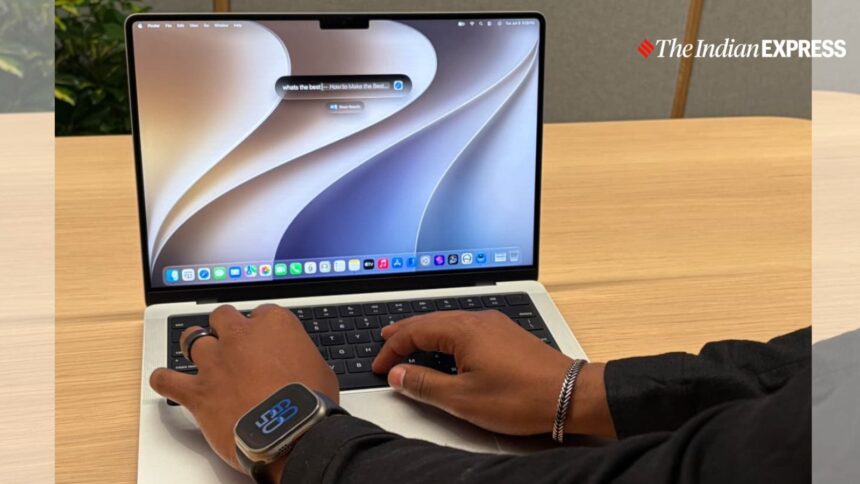
Among the hundreds of announcements at Apple’s Worldwide Developers Conference this year, Siri’s overhaul received the most attention, and I am not surprised. Apple’s digital assistant has been struggling to stay relevant for years.
, however, Apple moves away from a command-based assistant toward a conversational and context-aware agent capable of understanding what is on a user’s screen, searching across personal content, incorporating world knowledge, and taking actions across applications.
I think Siri shines most in a voice-first interface on the iPhone. It’s still early days for Siri AI, and Apple seems to acknowledge that, which is why consumers will gain access to it through a public beta later this year. A widespread launch may not happen before 2027.
While Google, OpenAI, Anthropic, and Microsoft are racing to build frontier AI models and investing billions in AI infrastructure, Apple’s strategy is to make AI a fundamental part of the platform itself, a strategy that became more obvious at WWDC 2026. This could be the structural shift no one is talking about. Developers are the backbone of how Apple views AI – not as an application, but as a platform capability woven throughout the software stack. AI is becoming the interface.
Perhaps one announcement that didn’t receive much attention was Apple’s expansion of its Foundation Models framework. By bringing on-device models that power Apple Intelligence to the forefront, Apple is giving developers new capabilities to integrate AI directly into applications without necessarily relying on external model providers.
Right now, everybody assumes that the cloud is the future of AI. That model works, but it comes with added costs, latency, privacy concerns, API fees, and infrastructure complexity. On-device AI offers an alternative to the cloud, and many application scenarios can be handled locally, especially as device hardware becomes more powerful.
Apple clearly views privacy and efficiency as the right approach, though it remains to be seen how developers respond. However, organisations are clearly concerned about sending their data to third-party services.
Many also missed the point that App Intents, Apple’s existing framework for exposing app actions to system-level services such as Siri and Shortcuts, serves as a bridge between applications and Apple’s AI ecosystem. AI systems need to understand both language and the actions behind it. For enterprises that offer mobile applications, adopting Apple’s frameworks could allow Siri to find, summarise, update, or act on app content without developers having to build a separate chatbot interface.
Instead of opening an app, users could simply ask Siri to perform an action on a specific object they are viewing or retrieve a related item from another application. Think of Siri as becoming an app action layer.
One also needs to understand that consumers are just getting started with AI assistants, and if you are an organisation, you can no longer rely on mobile app downloads, search ranking and consumer attention. AI recommendations will play a huge role, as will AI visibility and AI trust.
The real story, in my view, is how Apple is building the AI architecture behind the scenes. On the front end, Apple Intelligence may appear to be a suite of AI features embedded throughout the software. On the back end, however, it combines on-device foundation models, Private Cloud Compute, semantic indexing, App Intents, personal context, visual intelligence, and orchestration into a single, unified experience.
Apple executives referred to this as a “modern architecture,” which serves as the foundation for Siri. More importantly, the underlying AI stack is designed as a context and execution architecture – one that not only understands user intent but can also act on it across applications and services.
Together, App Intents, Siri, Private Cloud Compute, and Foundation Models form the foundation of AI-native experiences, combining actions, intelligence, orchestration, and privacy into a unified architecture.
In many ways, Apple is laying the groundwork for AI-first wearable experiences while simultaneously building an AI stack that spans consumer-facing assistant capabilities (exactly what Siri was originally designed to be), developer integration frameworks, and both on-device and private-cloud model infrastructure.
This architecture could also be mirrored in enterprise AI as organisations adopt model abstraction, orchestration layers, Model Context Protocol (MCP), agent-to-agent architectures, and agent ecosystems designed to leverage multiple specialised models. The combination of context, intelligence, orchestration, execution, and trust represents the foundation of future AI experiences.
While some may call Apple a conservative company that takes years to embrace new trends, WWDC 2026 demonstrated that it is ready to change how software is developed. Take Xcode 27, for example, which brings fully agentic AI coding into the development workflow by integrating models from Google, OpenAI, and Anthropic. Agents can assist with everything from design and prototyping to testing, debugging, deployment, and maintenance, enabling the coding assistant to simulate and help build entire applications.
One must ask whether Apple’s AI strategy is truly more than a Siri makeover, and that increasingly appears to be the case. Apple’s long-term AI ambitions hinge on three factors: if developers adopt its app-intelligence frameworks; whether Siri can deliver on the promise of a conversational, context-aware AI assistant and evolve into a system-wide interface for apps, data, and workplace actions across the iPhone, iPad, Mac, Apple Watch, and Vision Pro; and how effectively Apple can bring enterprises on board with stronger governance assurances and an additional layer of privacy.
If Apple gets it right and succeeds in making AI part of consumers’ daily workflows, without users even realising it’s running in the background, it would be a win for the company.

